
Alphabet’s extraordinary stock market collapse has erased approximately $500 billion from Google’s parent company in a single trading session. But could the sell-off signal something considerably more serious than disappointing corporate earnings — a potential reversal of the artificial intelligence investment boom and an emerging threat to the US economy?
Google’s stock crash is extremely unlikely to cause a recession on its own. The greater concern is that it may expose vulnerabilities within an AI investment cycle that has become an increasingly important contributor to US economic growth.
The distinction is fundamental. A $500 billion reduction in stock market value does not translate directly into a $500 billion contraction in economic output. However, if concerns over AI profitability spread across the technology sector and lead to substantial reductions in infrastructure spending, the consequences could extend into business investment, employment, credit markets and consumer expenditure.
Research from J.P. Morgan suggests AI-related investment accounted for roughly one-fifth of US economic growth over the period examined. Meanwhile, the Bank of England has already modelled how a severe AI-related financial market correction could materially weaken the British economy.
Neither finding establishes that a recession is approaching. Together, they explain why Alphabet’s collapse deserves attention beyond the technology sector.
Why did Google stock crash?
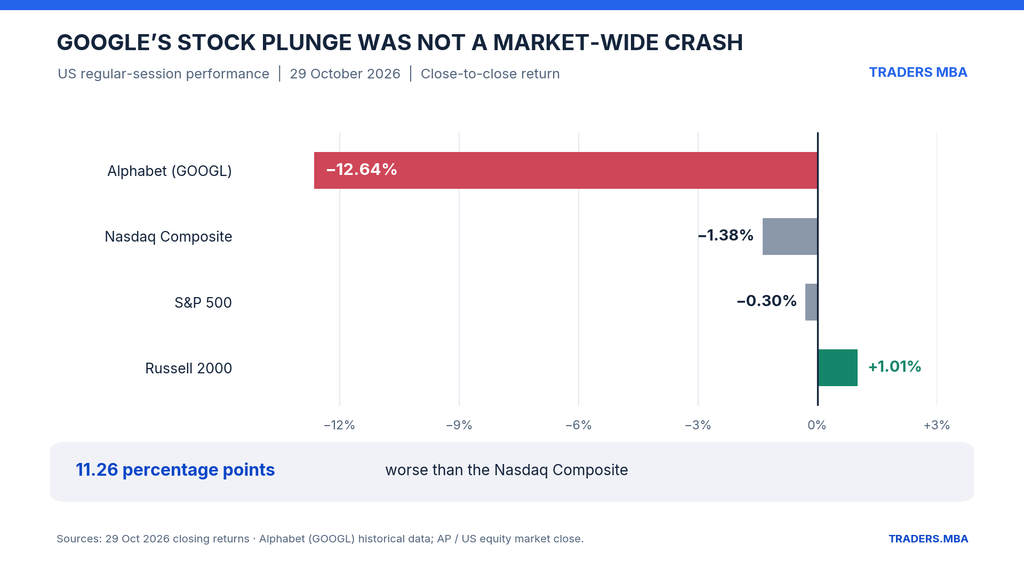
Alphabet’s Class A shares (NASDAQ: GOOGL) plunged 12.64% on Thursday, 29 October 2026, closing at $283.82, down from $324.89 the previous day.
The decline eliminated approximately $500 billion in market capitalisation, making it one of the largest single-day shareholder valuation losses in US corporate history.
The immediate catalyst was Alphabet’s third-quarter earnings announcement.
According to the company’s official financial results, consolidated revenue increased 25% year over year to $127.6 billion, while operating income rose approximately 30%.
Google Cloud performed exceptionally well, with revenue increasing 103% to $30.7 billion.
Yet investors focused on three developments that raised questions about the company’s future profitability.
First, Google Search revenue growth slowed to 12%, compared with approximately 17% during the preceding quarter. Although search activity continued increasing, the results raised concerns about whether AI-powered search experiences could generate advertising revenue as efficiently as traditional search.
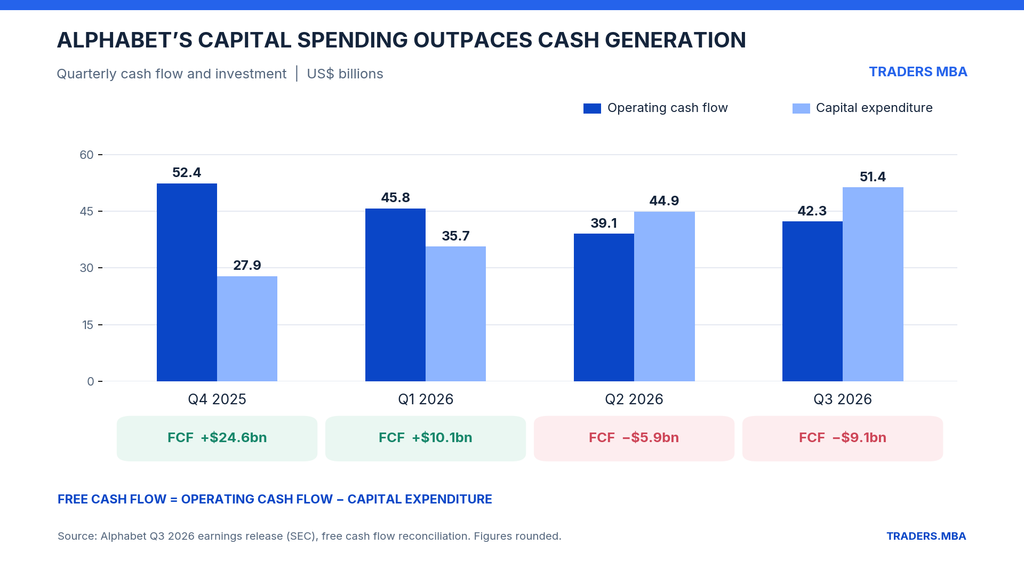
Second, Alphabet spent $51.4 billion on capital expenditure during the quarter, exceeding its $42.3 billion in operating cash flow.
Quarterly free cash flow consequently turned negative by approximately $9.1 billion.
Third, management maintained its 2026 capital expenditure outlook of $195–205 billion while indicating that investment would increase significantly in 2027.
Investors were therefore confronting a difficult financial question: can Alphabet preserve the profitability of its traditional Search business while simultaneously financing an increasingly capital-intensive AI infrastructure expansion?
The broader stock market tells a different story
Despite Alphabet’s extraordinary decline, the wider US equity market remained comparatively resilient.
| Market | 29 October 2026 |
|---|---|
| Alphabet (GOOGL) | -12.64% |
| Nasdaq Composite | -1.38% |
| S&P 500 | -0.30% |
| Russell 2000 | +1.01% |
Sources: Alphabet historical market prices and US equity index closing data, 29 October 2026.
Alphabet underperformed the Nasdaq Composite by approximately 11.3 percentage points.
Meanwhile, the Russell 2000, representing smaller US companies, actually advanced.
This divergence is significant. Investors were reassessing the financial outlook for Alphabet and selected technology companies, but the session did not display the widespread selling ordinarily associated with an immediate systemic financial crisis.
A severe company-specific correction had occurred. A broad economic collapse had not.
Can a $500 billion stock market loss cause a recession?
Not directly.
Market capitalisation represents the market value of a company’s outstanding shares. When share prices decline, investors reduce their valuation of future corporate earnings and cash flows.
That is not the same as money physically disappearing from the economy.
Alphabet did not lose $500 billion from its bank accounts. Nor did its stock market decline automatically destroy productive infrastructure, eliminate employment or reduce US economic output by an equivalent amount.
Nevertheless, persistent stock market losses can affect the real economy through what economists call the wealth effect.
When households experience investment losses, some reduce expenditure. Lower consumption can subsequently affect corporate revenues, employment and business investment.
But the scale of this effect depends on several factors, including who owns the shares, whether the losses persist and how households respond.
An isolated decline in Alphabet’s valuation would be unlikely to create a meaningful contraction in nationwide household expenditure.
A substantial correction affecting much of the technology sector would be more consequential, particularly given the concentration of major technology companies within widely held equity indices, investment funds and retirement portfolios.
The critical issue is therefore not the dollar value of Alphabet’s individual market loss. It is whether the shock spreads into broader financial markets and eventually changes economic behaviour.
The AI investment boom has become an important driver of US economic growth
Artificial intelligence is no longer simply a technology investment theme.
It is increasingly influencing capital expenditure across data centres, semiconductor manufacturing, electricity infrastructure, construction, networking equipment and specialised engineering.
These investments support economic activity through multiple channels.
Data centre construction creates demand for materials, labour, engineering services and electrical infrastructure. Advanced computing equipment supports semiconductor manufacturing and associated supply chains.
The scale of the expansion is substantial.
In research published on 2 September 2026, J.P. Morgan Asset Management estimated that major hyperscalers were on course to spend nearly $800 billion on capital expenditure during 2026, approximately ten times their expenditure in 2019.
That figure covers global spending, not exclusively AI expenditure within the United States.
J.P. Morgan also estimated that an AI-related investment proxy contributed 0.47 percentage points to the 2.1% growth in US real GDP over the preceding year, after accounting for imported hardware.
That represents approximately 22% of measured economic growth over the relevant period.
It does not mean AI represents 22% of the US economy.
Consumer expenditure contributed more than three times as much to economic growth during the period examined.
Nevertheless, AI-related investment has become sufficiently important that a substantial reversal could produce a measurable economic slowdown.
What would happen if AI stopped contributing to GDP growth?
The arithmetic illustrates the potential significance.
J.P. Morgan’s estimate can be decomposed as follows:
| Contribution to annual US real GDP growth | Percentage points |
|---|---|
| AI-related investment proxy | +0.47 |
| All other net contributions | +1.63 |
| Total real GDP growth | +2.10 |
Source: J.P. Morgan, September 2026. The non-AI figure is calculated as 2.10 minus 0.47 percentage points.
If AI investment’s positive growth contribution disappeared entirely while every other contribution remained unchanged, the measured growth rate would fall from 2.1% to approximately 1.63%.
That is a purely illustrative calculation, not a forecast. Changes in AI investment would also affect other industries, imports, employment and potentially productivity.
However, it demonstrates an important distinction.
Losing AI’s positive contribution to growth could slow the economy without causing a recession. An outright contraction in AI-related investment could create a greater economic drag, especially if it triggered secondary weakness elsewhere.
The real risk lies in a transition from rapidly expanding investment to a sustained decline in actual expenditure.
What happens if the AI investment boom begins to reverse?
A severe reduction in technology infrastructure investment could spread through the economy in stages.
Initially, major technology companies would postpone data centre construction or reduce equipment orders.
Semiconductor manufacturers, engineering companies and infrastructure suppliers would subsequently experience weaker demand.
Lower orders could reduce manufacturing output, while postponed construction projects might weaken employment growth.
As corporate revenues deteriorated, businesses could become more cautious about recruitment and further investment.
If those developments became sufficiently widespread, weaker employment and business confidence could eventually affect household expenditure.
The result could be a self-reinforcing economic slowdown.
However, an essential distinction must be preserved: reducing previously announced spending plans is not necessarily the same as reducing actual investment.
A technology company that lowers next year’s capital expenditure forecast from $100 billion to $80 billion may still be investing more than it did during the current year.
The effect on economic growth depends on changes in actual spending, not simply whether a forecast has been downgraded.
It also depends on where the expenditure occurs.
Equipment manufactured overseas does not contribute to US domestic production in the same way as construction undertaken within the United States.
This is why the nearly $800 billion global hyperscaler expenditure estimate cannot simply be treated as an equivalent addition to US GDP.
The key warning would be a coordinated reduction in actual investment across several major technology companies, rather than an isolated revision to one company’s share price.
Alphabet’s deteriorating free cash flow reveals why investors are concerned
Alphabet’s latest earnings provide a clear illustration of the tension between strong operating growth and escalating infrastructure expenditure.
Its quarterly free cash flow has deteriorated sharply.
| Quarter | Operating cash flow | Capital expenditure | Free cash flow |
|---|---|---|---|
| Q4 2025 | $52.4bn | $27.9bn | +$24.6bn |
| Q1 2026 | $45.8bn | $35.7bn | +$10.1bn |
| Q2 2026 | $39.1bn | $44.9bn | -$5.9bn |
| Q3 2026 | $42.3bn | $51.4bn | -$9.1bn |
Source: Alphabet Q3 2026 earnings release and free cash flow reconciliation. Figures rounded.
Between Q4 2025 and Q3 2026, quarterly free cash flow deteriorated by approximately $33.6 billion.
That change is significant, although the latest result requires context.
Management indicated that operating cash flow had been affected by inventory accumulation associated with TPU systems sales and a $5.2 billion payment relating to an earlier European Commission fine.
The negative free cash flow figure should therefore not be interpreted as a permanent quarterly cash shortfall.
Nor does it establish that Alphabet faces an immediate liquidity crisis.
Instead, it illustrates the growing financial demands of the AI infrastructure cycle.
The market is increasingly questioning whether higher capital expenditure will eventually generate sufficiently attractive incremental cash returns.
If investors begin asking the same question of the entire technology sector, the consequences could extend beyond Alphabet.
Financial contagion: The risk that extends beyond Silicon Valley
The most serious recession scenario would involve financial stress spreading from technology companies into the wider credit system.
AI infrastructure increasingly relies on complex financing arrangements.
These include corporate bonds, bank borrowing, private credit, equipment financing, long-term leases and structured investment vehicles.
Such arrangements can support productive investment, but they can also create vulnerabilities when underlying projects fail to generate anticipated revenues.
Consider a heavily financed data centre.
Its financial viability may depend on assumptions about future computing demand, customer utilisation and pricing.
If demand disappoints, project revenues could fall below expectations.
That might weaken borrowers’ ability to service debt and make refinancing more expensive.
If similar difficulties appeared across numerous projects, losses could affect private credit funds, institutional investors and other lenders.
Those institutions might respond by tightening financing conditions.
A technology-sector investment problem could then become a broader corporate credit problem.
Why central banks are monitoring AI financing
The Bank of England’s July 2026 Financial Stability Report identified rapid growth in debt financing associated with AI infrastructure.
The Bank cited OECD estimates indicating that private credit’s share of AI investment financing increased from 9% in 2024 to 34% in 2025.
It also highlighted increasing leverage, concentrated equity valuations and the growing complexity of infrastructure financing arrangements.
The International Monetary Fund’s October 2026 Global Financial Stability Report similarly identified an AI-related market correction as a potential source of wider financial instability.
The IMF warned that disappointing investment returns and earnings expectations could trigger asset-price declines amplified by leverage and concentrated exposures.
Neither institution concluded that a systemic AI credit crisis was underway.
Indeed, both identified important sources of resilience within the wider financial system.
Nevertheless, their assessments indicate that the risks surrounding AI investment have become relevant to financial stability, not simply technology-sector valuations.
The Bank of England has already modelled a severe AI market crash
One of the clearest demonstrations of the potential economic consequences comes from the Bank of England.
In July 2026, the Bank published a hypothetical scenario involving a severe reassessment of AI productivity and profitability expectations.
Its assumptions included a 45% decline in US equities over six quarters, a 350-basis-point increase in corporate credit spreads and persistent US Dollar depreciation.
The simulated shock produced a reduction in UK GDP of approximately 2.2 percentage points relative to the baseline economic path.
Financial-market transmission played a major role.
Equity-market effects accounted for approximately 36% of the estimated response, while wider corporate credit spreads accounted for approximately 50%.
These figures are especially significant because they demonstrate how a US-centred technology shock could affect economic activity in another country.
However, the modelling was a stress test, not a prediction.
It does not imply that US equities are about to decline 45%, that the UK economy will necessarily enter recession or that Alphabet’s sell-off will trigger such an event.
The Bank also reported that UK banks remained resilient under stress scenarios of comparable severity.
The finding is therefore best interpreted as evidence of a credible economic transmission mechanism rather than an imminent recession forecast.
Could this become another dot-com crash?
The comparison with the technology boom of the late 1990s is relevant, but the differences are equally important.
During the dot-com era, enormous amounts of capital flowed into internet companies and telecommunications infrastructure.
Expectations for future growth were often exceptionally optimistic.
When those expectations deteriorated, technology valuations collapsed and infrastructure investment contracted.
The subsequent investment downturn contributed to the economic weakness surrounding the 2001 US recession.
Artificial intelligence presents some comparable risks.
Companies may invest ahead of commercially sustainable demand. Infrastructure capacity could exceed requirements, while competition may reduce the profitability of computing services.
Technological improvements may also shorten the economically useful life of existing equipment.
However, today’s largest AI investors are generally established businesses with substantial revenues and operating profits.
Alphabet, Microsoft, Amazon and Meta possess financial resources that many speculative internet companies did not have during the late-1990s boom.
This reduces some financing vulnerabilities, although it does not eliminate the possibility of excessive investment.
A transformative technology can generate lasting economic benefits while some investors still earn disappointing financial returns.
The 1987 stock market crash provides another important lesson.
Despite an exceptionally severe equity market decline, the United States did not immediately enter recession.
The historical evidence therefore does not support the conclusion that a major technology sell-off must produce an economic contraction.
What does the latest US economic data reveal?
The latest official figures provide an important counterargument to predictions of an imminent recession.
According to the Bureau of Economic Analysis, the US economy expanded at an annualised real rate of 3.4% during the third quarter of 2026, accelerating from 2.2% in the preceding quarter.
Consumer spending and investment contributed to the expansion.
Private domestic final demand also remained strong.
These figures suggest the US economy entered the latest financial-market shock with substantial economic momentum.
At its 28 October meeting, the Federal Reserve maintained the federal funds target range at 3.75–4.00%.
The central bank described economic activity as expanding strongly, supported by resilient domestic spending and robust capital investment.
However, inflation remained elevated.
That creates a potential policy complication.
If AI-related investment weakened significantly while inflation remained above the Federal Reserve’s objective, policymakers could face competing pressures between supporting employment and containing price growth.
Nevertheless, the current economic evidence does not establish that the United States is entering recession.
The more defensible interpretation is that an expanding economy faces an emerging downside risk associated with the sustainability of the AI investment cycle.
What would an AI market crash mean for the US Dollar, Forex and Gold?
The potential consequences extend beyond equities because a serious technology investment downturn could change monetary policy expectations, Treasury yields and international capital flows.
However, the response would depend on whether the shock remained confined to technology valuations or developed into broader financial stress.
US Dollar: Two opposing forces
A severe global risk-off episode could initially support the US Dollar.
Investors often seek dollar liquidity during financial stress, particularly when reducing leveraged positions or meeting financing obligations.
However, a sustained deterioration in US economic growth could increase expectations of Federal Reserve interest rate cuts.
Lower expected US interest rates could eventually weaken the Dollar, particularly if other major economies proved more resilient.
The timing and intensity of the shock would therefore matter.
EUR/USD and GBP/USD: Relative growth and interest rates
A US-led economic slowdown could weigh on the Dollar if the Federal Reserve were expected to ease monetary policy more aggressively than the European Central Bank or Bank of England.
However, severe global financial stress could simultaneously damage European and British economic prospects.
This creates competing pressures.
Currency movements would depend on relative interest rates, growth expectations and investor demand for liquidity rather than the US economy alone.
Understanding these relationships is central to Forex fundamental analysis, where economic developments are evaluated through their effects on monetary policy, relative economic strength and international capital flows.
USD/JPY: Carry trades and risk aversion
A major deterioration in global risk sentiment could encourage investors to unwind Yen-funded carry trades.
Such position adjustments can support the Japanese Yen.
Nevertheless, changes in US-Japan interest rate differentials would remain a central influence on USD/JPY.
Gold: Safe-haven demand is not always immediate
Gold could benefit if a prolonged economic downturn reduced real interest rates and increased demand for defensive assets.
However, the initial stages of severe financial stress can also produce temporary selling as investors raise cash or meet margin requirements.
The interaction between Gold, Treasury real yields and the US Dollar would therefore remain critical.
For Forex and Gold markets, the most important distinction would be whether an AI-related sell-off generated temporary risk aversion or a lasting change in global monetary policy and economic expectations.
Three scenarios that could determine what happens next
The wider economic consequences depend on how the AI investment cycle develops.
| Scenario | Main development | Economic implication |
|---|---|---|
| Isolated correction | Alphabet and selected technology shares reprice | Limited direct recession risk |
| Investment slowdown | Hyperscalers reduce infrastructure expenditure | Slower investment and GDP growth |
| Systemic credit shock | Falling valuations combine with defaults and tighter lending | Potential broader recessionary pressure |
Scenario one: A contained technology correction
Alphabet’s decline remains primarily company-specific.
Other major technology companies maintain their investment programmes, while credit markets continue functioning normally.
Consumer spending and employment remain resilient.
Under these conditions, the broader economic effects would likely be limited.
Scenario two: A wider AI infrastructure slowdown
Technology companies become more cautious about committing additional capital.
Some data centre projects are delayed, semiconductor orders weaken and related industrial investment slows.
US GDP growth moderates, but other areas of economic activity continue expanding.
A recession would not necessarily follow.
Scenario three: An investment and financial contagion shock
A severe reassessment of AI profitability triggers substantial equity losses and infrastructure investment cuts.
Highly leveraged projects encounter refinancing difficulties.
Credit spreads widen, businesses reduce investment and employment conditions weaken.
A decline in household spending compounds the deterioration.
Under these circumstances, AI-related financial stress could become a meaningful contributor to recession.
The third scenario is economically credible but is not established by the currently available evidence.
Five warning indicators investors should monitor
For investors assessing the broader economic implications, developments in AI investment and credit markets will be more informative than Alphabet’s share price alone.
1. Hyperscaler capital expenditure: Are major technology companies collectively reducing actual infrastructure investment rather than merely revising future forecasts?
2. Semiconductor and data centre demand: Are equipment orders weakening, projects being cancelled or infrastructure utilisation declining?
3. Corporate credit spreads: Are higher borrowing costs spreading beyond individual AI infrastructure borrowers?
4. Labour market conditions: Are technology-related employment reductions beginning to influence the broader US labour market?
5. Consumer expenditure: Is weaker confidence translating into a sustained deterioration in real household spending?
A coordinated deterioration across these indicators would provide substantially stronger evidence of recession risk than another isolated technology sell-off.
Frequently asked questions
Could Google’s stock market crash trigger a US recession?
Google’s individual share price decline is highly unlikely to cause a US recession. The more serious risk would arise if the sell-off triggered a broader technology investment downturn, tighter credit conditions and sustained weakness in employment and consumer spending.
Is the artificial intelligence investment boom a financial bubble?
The scale of AI investment and some elevated valuations create legitimate financial risks, but high expenditure alone does not establish the existence of a speculative bubble. The critical question is whether future revenue and cash flows will justify the capital invested.
Could a collapse in AI spending reduce US GDP?
Yes. AI-related infrastructure expenditure contributes to business investment and economic growth. A substantial decline could weaken GDP growth, although the effect would depend on the scale of the reduction, domestic economic exposure and responses from other sectors.
Would a technology stock market crash strengthen the US Dollar?
Not necessarily. Global financial stress can support the Dollar through safe-haven and liquidity demand, while expectations of aggressive Federal Reserve easing could weaken it. The direction would depend on the nature of the crisis and relative monetary policy expectations.
Conclusion: Google’s collapse is a warning, not a recession
Alphabet’s approximately $500 billion stock market loss does not establish that a recession is imminent.
The wider market reaction has been comparatively contained, major hyperscalers have not collectively announced an investment collapse, and the latest US economic data continue to indicate expansion.
However, the AI investment cycle has become large enough to influence economic growth and increasingly dependent on substantial financial commitments.
A severe reversal could therefore affect more than technology share prices.
It could weaken business investment, disrupt supply chains, constrain credit availability and eventually affect employment and household expenditure.
That possibility deserves attention, particularly given the vulnerabilities identified by the Bank of England and IMF.
The evidence also suggests that many leading technology companies retain significant financial resources, providing an important buffer against immediate systemic stress.
Google’s stock crash is not itself a recessionary event. The critical warning would emerge if declining confidence in AI profitability began translating into sustained reductions in capital expenditure, rising credit stress and weakening economic activity.
For financial markets, that transition would matter far more than the size of any individual company’s share price decline.
Further reading and professional trading education
For readers seeking a deeper understanding of how economic growth, interest rates, monetary policy and risk sentiment influence financial markets, explore the Traders MBA Forex Fundamental Analysis Masterclass.
The programme focuses on developing independent macroeconomic analysis, understanding currency market drivers and interpreting changing economic conditions through a structured analytical framework.
Research sources
- Alphabet Q3 2026 Earnings Release — SEC
- US Bureau of Economic Analysis — Q3 2026 GDP
- J.P. Morgan Asset Management — AI Investment and US Economic Growth
- Bank of England — July 2026 Financial Stability Report
- IMF — October 2026 Global Financial Stability Report
- Federal Reserve — October 2026 FOMC Statement