
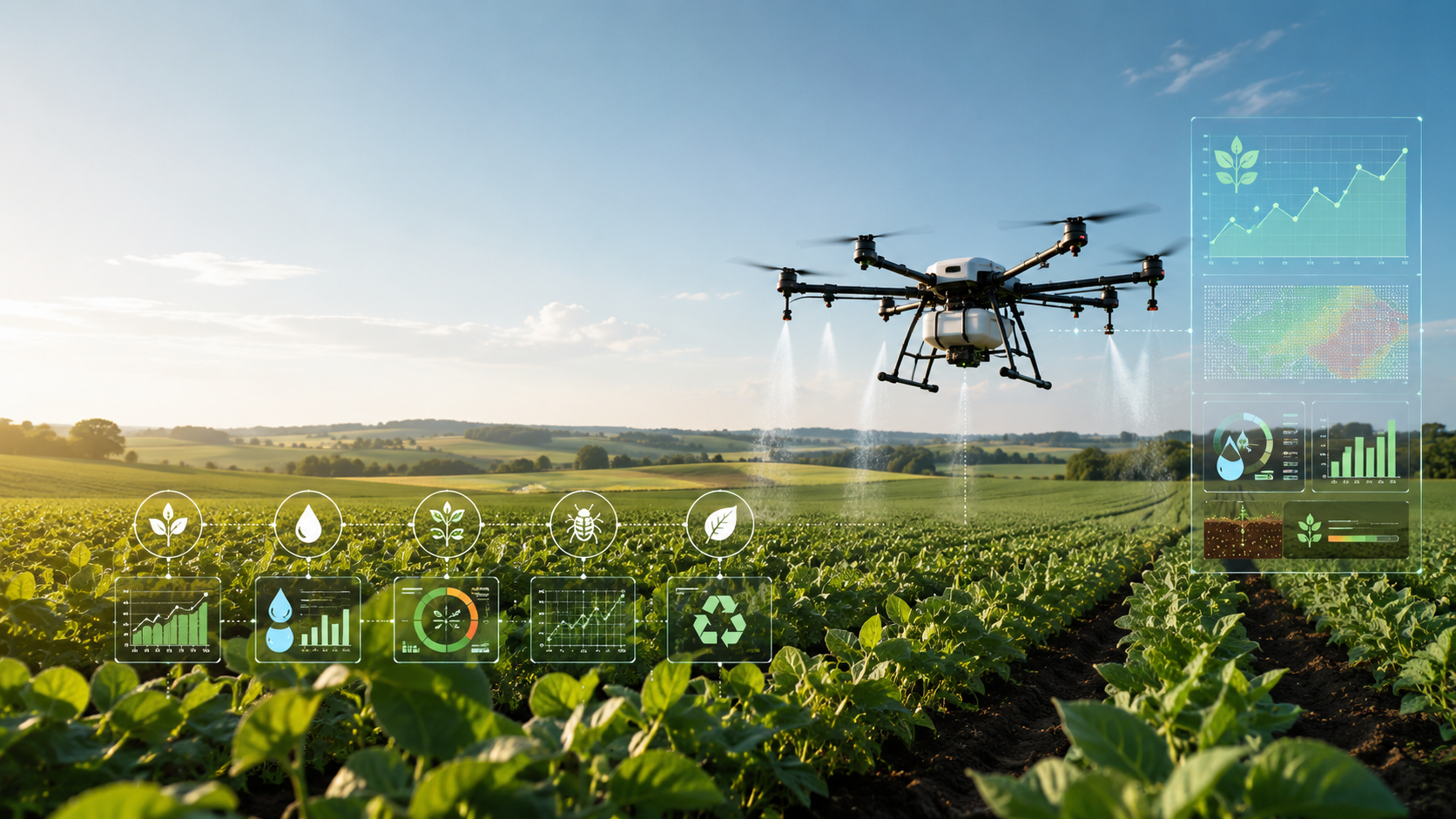
Agriculture is entering a new investment cycle.
The world needs to produce more food, but it must do so under tighter environmental rules, greater climate pressure, higher water stress, soil degradation and growing demand for residue-free food. That creates a long-term opportunity in crop protection, biological pesticides, biostimulants, seed treatments, precision agriculture and nutrient efficiency.
For traders and investors, this is not simply an ESG theme. It is a productivity theme.
Farmers need to protect yields. Governments want lower chemical risk. Food companies want more sustainable supply chains. Consumers want cleaner food. Input suppliers want new growth markets. That combination is pushing agriculture away from a simple “more chemicals equals more output” model and towards a more integrated system built around smarter products, targeted application and biological alternatives.
The investment opportunity is broad. It includes specialist biological crop protection companies such as Eden Research and Bioceres, larger agricultural platforms such as Corteva, Bayer, Syngenta, BASF, FMC and UPL, biosolutions companies such as Novonesis, precision agriculture leaders such as Deere, Trimble, AGCO and CNH Industrial, and fertiliser or nutrient-efficiency businesses such as Yara, Nutrien, ICL and Mosaic.
The key question is not whether sustainable farming is a real long-term theme. It is. The harder question is which companies can convert that theme into durable revenue, margins and cash flow.
Key Takeaways
Crop protection is becoming a long-term investment theme because agriculture must produce more food under tighter resource, climate and regulatory constraints.
Biological pesticides, biostimulants, seed treatments, precision spraying and nutrient-efficiency products are growing faster than many traditional agricultural input categories.
Regulation is a major driver. The EU, UK, US, Brazil and India are all reshaping how pesticides, bioinputs and biostimulants are approved, used and monitored.
Large diversified platforms such as Corteva, Novonesis, Deere, Yara and ICL may offer more resilient exposure, while smaller names such as Eden Research and Bioceres offer higher thematic purity but higher risk.
The strongest investment opportunities are likely to come from companies with scalable technology, proven farmer value, regulatory execution, global distribution and balance-sheet strength.
This article is for education and market research only. It is not financial advice or a recommendation to buy or sell any security.
What Is Crop Protection?
Crop protection refers to the products, technologies and farming practices used to protect crops from insects, weeds, fungi, diseases, nematodes and environmental stress.
Traditionally, crop protection was dominated by synthetic chemical pesticides. These include herbicides, fungicides, insecticides and nematicides. They remain essential in modern agriculture because crop losses from pests and disease can be severe.
However, the market is changing.
Crop protection now includes a wider range of tools:
| Category | What It Means | Why It Matters |
|---|---|---|
| Synthetic pesticides | Chemical products used to control pests, weeds and diseases | Still central to crop yield protection, but facing tighter regulation |
| Biological pesticides | Naturally derived or microorganism-based crop protection products | Lower-residue and often more compatible with sustainable farming systems |
| Biostimulants | Products that improve nutrient efficiency, crop quality or stress tolerance | Help crops cope with drought, heat, poor soils and nutrient stress |
| Seed treatments | Biological, chemical or physical treatments applied to seeds before planting | Protects early crop development and can improve establishment |
| Integrated Pest Management | A systems-based approach combining monitoring, prevention and targeted treatment | Reduces unnecessary pesticide use while protecting yield |
| Precision agriculture | Data, sensors, machines and software used to apply inputs more accurately | Can reduce waste, lower costs and improve environmental performance |
| Enhanced-efficiency fertilisers | Fertilisers designed to improve nutrient uptake and reduce losses | Important for lower-emission and lower-waste farming |
In simple terms, crop protection is no longer just about spraying more chemicals. It is increasingly about using the right input, at the right time, in the right place, with the lowest practical waste.
Why Crop Protection Matters for Food Security
Crop protection matters because global food security depends on yield protection.
The Food and Agriculture Organization has estimated that plant pests and diseases can destroy up to 40% of global crops each year. That is a major economic and food-security risk. At the same time, the world population is expected to keep rising towards 2050, while climate change is making farming conditions more volatile.
This creates a structural challenge.
Farmers need to produce more food, but they are doing so against a backdrop of:
| Pressure | Impact on Agriculture |
| Population growth | More food demand over the long term |
| Climate change | More heat, drought, flooding and pest pressure |
| Water scarcity | Greater need for efficient irrigation and input use |
| Soil degradation | Lower natural productivity and more need for soil health solutions |
| Pest resistance | Existing chemical tools may become less effective over time |
| Regulation | Higher scrutiny of synthetic pesticide use |
| Consumer pressure | Demand for lower-residue and sustainably produced food |
| Food inflation | Greater political focus on agricultural productivity |
This is why crop protection should not be viewed only as an environmental theme. It is also a supply-chain resilience theme, a food-security theme and a productivity theme.
For investors, those themes matter because they can create multi-year demand for companies that help farmers protect output while meeting stricter rules.
Why Sustainable Farming Is Becoming an Investment Theme
Sustainable farming is becoming investable because the economics are starting to matter more.
For years, sustainable agriculture was often discussed in broad environmental terms. Today, it is increasingly linked to farm margins, input efficiency, regulatory compliance and supply-chain access.
Farmers are under pressure to reduce unnecessary pesticide use, manage fertiliser costs, protect soil health and demonstrate more sustainable production practices. At the same time, they cannot afford to sacrifice yield. A product that is environmentally attractive but does not work reliably in the field will struggle to gain adoption.
That is why the most interesting companies are not just “green agriculture” companies. They are businesses that can help farmers solve practical problems.
The most important areas are:
| Area | Investment Relevance |
| Biological crop protection | Potentially faster-growing alternative or complement to synthetic pesticides |
| Biostimulants | Helps crops manage abiotic stress such as heat, drought and nutrient pressure |
| Seed treatments | Early-stage crop protection with strong scalability |
| Precision spraying | Reduces input waste and supports targeted application |
| Digital agronomy | Helps farmers make better decisions using data |
| Nutrient efficiency | Improves fertiliser use and reduces losses |
| Low-carbon fertilisers | Links farming productivity with emissions reduction |
The market opportunity is not about replacing all conventional agriculture overnight. It is about gradual adoption of integrated systems where biologicals, precision tools and conventional inputs work together.
That matters because it makes the theme more realistic.
The Market Opportunity in Crop Protection and Biologicals
The global crop protection market is already large. Third-party estimates vary, but the research points to a market worth tens of billions of dollars today, with continued growth expected over the coming decade.
The more interesting growth area is agricultural biologicals.
Biological crop protection, biostimulants and biofertilisers are generally expected to grow faster than traditional crop protection chemicals. Corteva has previously framed biologicals as a market that could represent around a quarter of the total crop solutions market by 2035. That is significant because it suggests biologicals are moving from niche category to mainstream strategic priority.
| Market Segment | Investment Reading |
| Crop protection chemicals | Large, mature and still essential to global agriculture |
| Agricultural biologicals | Faster-growing subsegment with potential premium valuations |
| Biostimulants | Linked to climate stress, yield resilience and nutrient efficiency |
| Precision agriculture | Scales through equipment, sensors, software and application systems |
| Nutrient efficiency | Benefits from fertiliser cost pressure, regulation and emissions focus |
For investors, the key point is that market growth alone is not enough. A company must have the right product, regulatory approvals, commercial distribution and financial resilience to capture that growth.
The Regulation Driving Change
Regulation is one of the biggest forces shaping this theme.
In the EU, the Farm to Fork strategy set an ambition to reduce the use and risk of chemical pesticides and reduce the use of more hazardous pesticides by 2030. The proposed Sustainable Use Regulation was later withdrawn, showing that policy can move in uneven ways. However, the direction of travel remains clear: Europe wants lower-risk crop protection and greater use of integrated pest management.
In the UK, the 2025 Pesticides National Action Plan introduced domestic targets based on pesticide load indicators and promoted integrated pest management. That supports a gradual shift towards more targeted, lower-risk and better-justified pesticide use.
In the US, the Environmental Protection Agency has a separate framework for biopesticides. That can make the US an attractive launch market for biological crop protection companies because the regulatory path can be more defined than in some other jurisdictions.
Brazil and India are also important. Brazil is a major agricultural market with strong bioinputs momentum, while India has formalised rules around biostimulants. That matters because sustainable agriculture is not only a European story.
| Region | Why It Matters |
| EU | Strong policy pressure to reduce chemical pesticide risk |
| UK | Domestic pesticide reduction and integrated pest management targets |
| US | Clearer biopesticide approval pathway and major commercial market |
| Brazil | Fast-growing bioinputs market and large agricultural base |
| India | Formal biostimulant regulation supports legitimacy and quality control |
Regulation can create both opportunity and risk.
For biological crop protection companies, regulatory approvals can become major valuation catalysts. For traditional agrochemical companies, tighter rules may pressure older products but also create demand for newer, lower-risk solutions.
The challenge is timing. Approvals can take longer than expected, especially for smaller companies with limited resources. That makes regulation both a tailwind and a risk factor.
Which Companies Are Exposed to Crop Protection and Sustainable Farming?
This is not a single-stock theme. It is a layered ecosystem.
The companies involved can be grouped into five broad categories:
- Specialist biological crop protection and biologicals companies
- Diversified crop-input and seed leaders
- Biosolutions and speciality ingredient companies
- Precision agriculture and agri-tech businesses
- Fertiliser and nutrient-efficiency companies
Each group offers a different balance of upside, risk, liquidity and thematic purity.
Specialist Biological Crop Protection Companies
Specialist biological crop protection companies offer the most direct exposure to the theme. They may benefit most if biologicals gain share, but they also carry the highest risk.
Eden Research
Eden Research is an AIM-listed specialist in sustainable crop protection. Its products include biofungicide, bionematicide and seed-treatment technologies. The company is a clearer pure-play on biological crop protection than many larger agricultural groups.
That purity is attractive, but it also brings risk. Eden is small, still loss-making based on the research data, and dependent on commercial execution, regulatory approvals, distribution partners and continued funding discipline.
For investors, Eden Research is best viewed as a higher-risk, higher-upside specialist exposure to biological crop protection rather than a core agriculture holding.
Bioceres Crop Solutions
Bioceres offers exposure to climate-smart agriculture, crop protection, crop nutrition and seed technologies. It is more developed than many micro-cap biological names, but it also carries balance-sheet and country-specific risks, particularly linked to Argentina and the commercial development of its technology platforms.
Bioceres may appeal to investors seeking higher-beta exposure to biologicals and climate-resilient agriculture, but it is not a simple low-risk compounder.
Private Biologicals Leaders
Private companies such as Certis Biologicals, Andermatt, Koppert and Biobest are important because they show that biological crop protection is already a commercial market, not just a research concept.
They may not be directly investable through public markets, but they matter for sector benchmarking, partnership activity and potential merger and acquisition themes.
| Company | Exposure | Investor Relevance |
| Eden Research | Biological crop protection and seed treatment | High-purity public exposure, but high funding and execution risk |
| Bioceres | Climate-smart seeds, biologicals and crop inputs | Speculative public exposure with technology upside and balance-sheet risk |
| Certis Biologicals | Biopesticides | Private benchmark for biological crop protection |
| Andermatt | Biologicals and biocontrol | Private global biocontrol platform |
| Koppert | Biological crop protection and pollination | Proof of commercial adoption in biological systems |
| Biobest | Biological crop protection and pollination | Important private player in protected crops and biological systems |
Diversified Crop-Input and Seed Leaders
The larger crop-input companies offer broader and often more resilient exposure. Their biologicals exposure may be less pure, but they have the distribution networks, regulatory teams and commercial scale needed to bring products to market globally.
Corteva
Corteva is one of the cleanest large-cap public equity exposures to this theme. It combines seeds, crop protection, biologicals, seed-treatment capability and digital agriculture.
Its acquisitions of Symborg and Stoller strengthened its biologicals platform. That gives Corteva exposure to both traditional crop protection and the faster-growing biologicals segment.
For investors seeking large-cap, liquid exposure to sustainable agriculture, Corteva is one of the strongest watchlist names.
Bayer Crop Science
Bayer has a powerful crop science franchise, including seeds, traits, crop protection, seed treatment and digital agriculture. It also has exposure to biological fungicides, biological insecticides and biostimulants.
However, Bayer’s equity story is complicated by broader group issues, including litigation, debt and the performance of non-agricultural divisions. That makes the agricultural exposure strong operationally but less pure from an equity-market perspective.
Syngenta
Syngenta is one of the most important crop-protection and seeds platforms globally. It has meaningful exposure to biologicals and seedcare, particularly in markets such as Brazil.
However, it is not directly listed in the same straightforward way as some other public-market names, which limits access for many equity investors.
BASF Agricultural Solutions
BASF Agricultural Solutions offers seeds, traits, chemical and biological crop protection, seed treatment and digital tools. BASF has also expanded into biological pest control through acquisitions and partnerships.
The issue is that BASF is a broad chemicals group. Agricultural Solutions is important, but the stock is also influenced by wider chemical-market cycles, energy costs and industrial demand.
FMC
FMC is a crop-protection company with plant-health exposure, including biologicals, crop nutrition and seed treatment. It offers liquid public exposure to crop protection, but leverage and business reset risks make it more complex.
For investors, FMC is a turnaround-plus-theme idea rather than a simple sustainable agriculture compounder.
UPL
UPL is a broad crop-input platform with crop protection, seeds, biosolutions, post-harvest and soil-and-water technologies. Its “openAg” positioning gives it clear sustainability exposure.
However, UPL remains a broad emerging-markets agricultural input business, so the stock is influenced by debt, working capital, currency, crop cycles and channel inventory conditions.
| Company | Main Exposure | Investor View |
| Corteva | Seeds, crop protection, biologicals and digital agriculture | Strong large-cap platform exposure |
| Bayer Crop Science | Seeds, traits, crop protection and biologicals | Strong agricultural business, but group-level complexity |
| Syngenta | Crop protection, seeds and biologicals | Operationally important, but limited direct public access |
| BASF Agricultural Solutions | Crop protection, seeds, biologicals and digital tools | Good exposure, diluted by wider chemicals business |
| FMC | Crop protection and plant health | Liquid exposure but turnaround and leverage risk |
| UPL | Crop inputs, biosolutions and emerging-market agriculture | Broad exposure with balance-sheet and cycle considerations |
Biosolutions and Speciality Ingredient Companies
Some of the most attractive long-term exposures may not be conventional agrochemical companies. They may be businesses that supply the biological platforms, formulation know-how or speciality ingredients needed to make sustainable agriculture work at scale.
Novonesis
Novonesis is a high-quality biosolutions company with exposure to agriculture through microbes, enzymes, inoculants and biological crop technologies.
Its strength is that it is not dependent on one agricultural product. It is a broader biology platform with strong profitability and multiple end markets. That can make it attractive for investors who want exposure to biological innovation without taking single-product crop-protection risk.
Croda
Croda offers more indirect exposure through adjuvants, formulation aids, seed enhancement and biostimulant-related technologies.
This is a “picks and shovels” exposure. Croda may benefit as crop protection becomes more complex, especially if biological products require better delivery systems, compatibility and formulation performance.
| Company | Role in the Theme | Why It Matters |
| Novonesis | Microbes, enzymes, inoculants and biosolutions | High-quality biology platform with lower single-product risk |
| Croda | Formulation, adjuvants, seed enhancement and speciality ingredients | Indirect enabler of biological and precision agriculture adoption |
Precision Agriculture and Agri-Tech Stocks
Precision agriculture is central to sustainable farming because reducing input use does not always mean replacing one product with another. Often, it means applying existing inputs more accurately.
That is why equipment and software companies belong in this theme.
Deere & Company
Deere is a precision agriculture leader. Technologies such as See & Spray and ExactApply are designed to apply herbicides and other inputs more selectively. That links directly to reduced waste, lower input cost and more targeted crop protection.
Deere is not a pure sustainable farming stock. It is still a cyclical machinery business. But over the long term, precision agriculture can become a powerful growth and margin driver.
Trimble
Trimble provides positioning, data and precision systems. Its agriculture assets were combined with AGCO’s precision platform into PTx Trimble, creating a mixed-fleet precision agriculture business.
Trimble is less direct than Deere, but it remains an important enabler of digital and precision farming systems.
AGCO
AGCO has become one of the clearest listed precision agriculture names through its ownership of PTx Trimble. Its ambition to grow precision-ag sales over the coming years makes it relevant to this theme.
The key risks are machinery cyclicality, integration execution and farmer spending cycles.
CNH Industrial
CNH offers agricultural equipment and precision technology. Products such as SenseApply fit the “sense and act” model of sustainable agriculture, where equipment detects field conditions and applies inputs only where needed.
CNH is relevant, but it is more cyclical and structurally complex than Deere.
| Company | Precision Agriculture Exposure | Key Risk |
| Deere | See & Spray, ExactApply, digital farming systems | Equipment cycle weakness |
| Trimble | Positioning, data and mixed-fleet precision systems | Less direct agriculture exposure after JV structure |
| AGCO | PTx Trimble and machinery platform | Integration and machinery cycle risk |
| CNH Industrial | Precision equipment and application systems | Debt, financing and cyclicality |
Fertiliser and Nutrient-Efficiency Companies
Sustainable farming is not just about pesticides. It is also about fertiliser efficiency.
Fertilisers are essential to global food production, but they are linked to energy costs, emissions, nutrient runoff and farmer input inflation. That creates demand for products and systems that improve nutrient-use efficiency.
Nutrien
Nutrien is a major potash, nitrogen and retail agronomy business. It offers exposure to fertiliser demand, farmer services and enhanced-efficiency products such as controlled-release nitrogen.
The main issue is that Nutrien remains highly exposed to fertiliser price cycles.
Yara International
Yara is one of the stronger names in nutrient efficiency, premium crop nutrition, digital farming and low-carbon fertiliser strategies.
It offers a cleaner link to sustainable nutrient management than some commodity fertiliser producers, although it still faces energy and fertiliser-cycle risks.
Mosaic
Mosaic is more directly exposed to phosphate and potash markets. It also has performance fertiliser products and an emerging biosciences angle, but its stock is still largely driven by commodity fertiliser cycles.
ICL Group
ICL offers a more specialty-oriented fertiliser and plant nutrition platform, including biostimulants and agriculture technology. It may offer a better balance between commodity exposure and specialty agriculture than some fertiliser peers.
| Company | Sustainable Farming Link | Investor View |
| Nutrien | Potash, nitrogen, retail agronomy and controlled-release nitrogen | Strong scale but fertiliser-cycle exposure |
| Yara | Premium nutrition, nutrient efficiency and low-carbon fertilisers | Stronger sustainability link |
| Mosaic | Potash, phosphate and performance fertilisers | More cyclical commodity exposure |
| ICL | Specialty fertilisers, biostimulants and Growing Solutions | Balanced exposure to specialty nutrition |
Company Comparison Table
| Company | Main Exposure | Pure-Play or Diversified? | Why It Matters | Key Risk |
| Eden Research | Biological crop protection and seed treatment | Pure-play public | Direct exposure to biologicals and regulatory catalysts | Funding, execution and liquidity risk |
| Bioceres | Climate-smart inputs, seeds and biologicals | Focused public | Higher-beta exposure to sustainable agriculture | Debt, country risk and adoption risk |
| Corteva | Seeds, crop protection, biologicals | Focused agriculture public | Strong large-cap platform | Crop cycles and valuation |
| Novonesis | Biosolutions, microbes and enzymes | Diversified biosolutions | High-quality biology enabler | Agriculture is only part of the group |
| FMC | Crop protection and plant health | Diversified crop-input public | Liquid crop-protection exposure | Leverage and turnaround risk |
| UPL | Crop inputs and biosolutions | Diversified crop-input public | Emerging-market agriculture exposure | Debt, working capital and cycle risk |
| Bayer | Seeds, traits and crop protection | Conglomerate public | Powerful crop science platform | Litigation and group complexity |
| Syngenta | Seeds, crop protection and biologicals | Group-owned/private structure | Major global agriculture player | Limited direct public access |
| BASF | Agricultural Solutions | Conglomerate public | Biologicals and digital agriculture exposure | Wider chemicals cycle |
| Croda | Formulation, adjuvants and seed enhancement | Specialty ingredients public | Picks-and-shovels exposure | Indirect thematic purity |
| Deere | Precision agriculture | Machinery public | Leading application technology | Equipment-cycle risk |
| Trimble | Precision data and positioning | Diversified technology public | Digital and mixed-fleet farming systems | Indirect exposure |
| AGCO | Machinery and PTx Trimble | Machinery and precision public | Clear precision-ag ambition | Integration and cycle risk |
| CNH | Machinery and precision systems | Machinery and finance public | Input-efficiency technology | Debt and cyclicality |
| Nutrien | Potash, nitrogen and retail | Fertiliser public | Nutrient efficiency and agronomy | Fertiliser-price exposure |
| Yara | Crop nutrition and low-carbon fertiliser | Focused nutrition public | Strong nutrient-efficiency exposure | Energy and fertiliser cycle |
| Mosaic | Potash and phosphate | Commodity fertiliser public | Nutrient demand exposure | Commodity cyclicality |
| ICL | Specialty minerals and biostimulants | Specialty minerals public | Balanced plant nutrition exposure | Less pure than biological specialists |
The Long-Term Investment Thesis
The long-term thesis is that farming systems are moving from input intensity towards input efficiency.
That does not mean synthetic crop protection disappears. Conventional pesticides, fertilisers and machinery will remain essential to global agriculture. However, the value chain is shifting towards solutions that help farmers produce more output per unit of chemical, nutrient, water and labour.
The best-positioned companies are likely to have one or more of the following strengths:
| Strength | Why It Matters |
| Proprietary biology | Creates differentiated biological crop protection or biostimulant products |
| Regulatory expertise | Helps companies secure approvals and expand labels |
| Distribution scale | Allows products to reach farmers globally |
| Seed-treatment capability | Scalable route to early crop protection |
| Precision application | Reduces waste and improves input economics |
| Digital agronomy | Supports better decision-making and traceability |
| Nutrient efficiency | Helps farmers manage cost, productivity and emissions |
| Balance-sheet strength | Allows companies to survive long commercialisation cycles |
The theme is attractive because it links several durable forces: food security, climate resilience, regulation, productivity and farm economics.
But it is also selective. Not every company using the language of sustainable farming will create shareholder value.
Who Benefits From This Theme?
The main beneficiaries are likely to be companies that solve real farmer problems.
Farmers will not adopt a product simply because it sounds sustainable. They will adopt it if it protects yield, lowers input waste, improves crop quality, reduces regulatory risk or supports access to premium supply chains.
That favours companies with practical, field-tested solutions.
| Beneficiary Type | Examples |
| Biological crop protection specialists | Eden Research, Bioceres, Certis, Andermatt, Koppert |
| Scaled agriculture platforms | Corteva, Bayer, Syngenta, BASF, FMC, UPL |
| Biology and formulation enablers | Novonesis, Croda |
| Precision application leaders | Deere, AGCO, Trimble, CNH |
| Nutrient-efficiency companies | Yara, Nutrien, ICL, Mosaic |
The highest-quality public-market exposure may not always come from the purest companies. Sometimes the better risk-reward sits with diversified enablers that have stronger cash flow, lower funding risk and more routes to commercial adoption.
What Could Go Wrong?
The biggest risk is that the narrative runs ahead of the economics.
Sustainable agriculture is a powerful long-term theme, but adoption can be slower than investors expect. Farmers are practical buyers. If a biological product does not work consistently, is too expensive, or cannot be easily integrated into existing farm systems, adoption may disappoint.
There are also major financial and regulatory risks.
| Risk | Why It Matters |
| Farmer adoption risk | Products must prove value in real field conditions |
| Product efficacy risk | Biologicals can be more variable than conventional chemistry |
| Regulatory delays | Approvals can take longer than expected |
| Funding risk | Small companies may need equity raises before reaching profitability |
| Dilution risk | Shareholders in small caps can be diluted if cash burn continues |
| Commodity cycles | Fertiliser and machinery stocks can move with crop prices and farmer income |
| Litigation risk | Some large agrochemical companies face legal overhangs |
| Greenwashing risk | Weak sustainability claims may not translate into revenue |
| Valuation risk | Exciting themes can become overpriced |
| Liquidity risk | Small-cap agricultural technology shares can be volatile and hard to exit |
This is why investors should not treat the sector as one broad buy list. The theme is real, but the winners and losers will be very different.
What Should Traders and Investors Monitor?
A practical trading framework should focus on catalysts, data and market conditions.
| Indicator | Why It Matters |
| Regulatory approvals | Can unlock new markets and revenue potential |
| Product label expansions | Increases addressable use cases |
| Farmer adoption data | Confirms whether products are moving beyond trials |
| Agricultural commodity prices | Influences farmer income and input spending |
| Fertiliser prices | Affects demand for nutrient-efficiency solutions |
| Weather events | Can increase demand for crop protection and resilience tools |
| Food inflation | Raises political attention on productivity |
| Earnings reports | Shows whether sustainability exposure is becoming revenue |
| Partnerships | Important for small companies needing distribution |
| M&A activity | Large players may buy biological or formulation assets |
| Balance-sheet updates | Critical for smaller or leveraged names |
| Machinery order books | Important for Deere, AGCO and CNH |
| Sector rotation | Agriculture can attract flows during food-security or inflation themes |
For smaller companies such as Eden Research and Bioceres, investors should pay close attention to cash, revenue acceleration, distribution agreements, regulatory approvals and product adoption.
For larger companies such as Corteva, Deere, Novonesis and Yara, the focus should be on whether the sustainability theme is material enough to influence group growth, margins and valuation.
Best Watchlist Buckets
The following is not a recommendation to buy or sell. It is a way to organise the theme for further research.
| Watchlist Bucket | Companies to Research | Suitable For |
| Higher-purity biologicals | Eden Research, Bioceres | Investors comfortable with high risk and volatility |
| Large-cap agriculture platforms | Corteva, Bayer, BASF, FMC, UPL | Investors seeking scale and liquidity |
| Biosolutions enablers | Novonesis, Croda | Investors seeking quality biology or formulation exposure |
| Precision agriculture | Deere, AGCO, Trimble, CNH | Investors focused on input efficiency and digital farming |
| Nutrient efficiency | Yara, Nutrien, ICL, Mosaic | Investors focused on fertiliser, emissions and crop nutrition |
A balanced thematic approach would usually separate core exposure from speculative exposure.
Core exposure may come from scaled, profitable platforms. Speculative exposure may come from smaller companies with higher upside but higher execution risk.
Final Verdict
Crop protection and sustainable farming are credible long-term investment themes because they sit at the centre of food security, climate resilience, regulation and agricultural productivity.
The world needs more food, but farming must increasingly operate with tighter restrictions on chemical risk, water use, soil degradation and emissions. That creates a structural opportunity for biological crop protection, biostimulants, seed treatments, precision application, digital agronomy and nutrient-efficiency technologies.
The strongest opportunities are unlikely to come from simply buying every company linked to agriculture. Returns are likely to be highly selective.
Companies such as Corteva, Novonesis, Yara, ICL, Deere, AGCO and Croda offer more scalable and financially resilient exposure to the theme. Smaller specialists such as Eden Research and Bioceres offer higher thematic purity, but also greater risks around funding, adoption, regulation and liquidity.
The best way to think about this sector is not “green agriculture”. It is higher-output agriculture under tighter constraints.
That makes crop protection and sustainable farming a serious long-term investment theme, but not a simple one.
FAQ
What is crop protection?
Crop protection is the use of products, technologies and farming practices to protect crops from insects, weeds, fungi, diseases, nematodes and environmental stress. It includes synthetic pesticides, biological pesticides, seed treatments, biostimulants, precision spraying and integrated pest management.
Are crop protection stocks a long-term investment opportunity?
They can be, but the opportunity is selective. The strongest companies are likely to be those that help farmers protect yield, reduce waste, meet regulatory requirements and improve productivity. Not every company exposed to agriculture will benefit equally.
What are biological pesticides?
Biological pesticides, or biopesticides, are crop protection products based on natural materials, microorganisms or biologically derived active ingredients. They are often used as lower-risk or lower-residue alternatives or complements to synthetic pesticides.
Why are biologicals growing?
Biologicals are growing because farmers, regulators and food supply chains are looking for crop protection and crop-enhancement tools that support lower residues, improved soil health, pest management and sustainable production. They also fit well within integrated pest management systems.
Is Eden Research a crop protection stock?
Yes. Eden Research is a specialist biological crop protection company listed on AIM. It offers relatively pure exposure to sustainable crop protection, but it is also a small, higher-risk company with commercialisation, funding and execution risks.
Which companies offer broader exposure to sustainable farming?
Corteva, Novonesis, Deere, AGCO, Yara, ICL, Croda, Nutrien, Bayer, BASF, FMC and UPL all offer different forms of exposure. Some are focused agriculture platforms, while others are diversified industrial, machinery, biosolutions or fertiliser companies.
Why include Deere and AGCO in a crop protection article?
Precision agriculture is part of the sustainable farming theme because it helps farmers apply herbicides, fertilisers and other inputs more accurately. Technologies such as precision spraying can reduce waste and improve input efficiency without requiring a complete shift away from conventional farming.
What are the main risks of investing in sustainable farming stocks?
The main risks include slow farmer adoption, weak product performance, regulatory delays, funding needs, dilution, commodity cycles, fertiliser price volatility, machinery downcycles, litigation and overvaluation.