
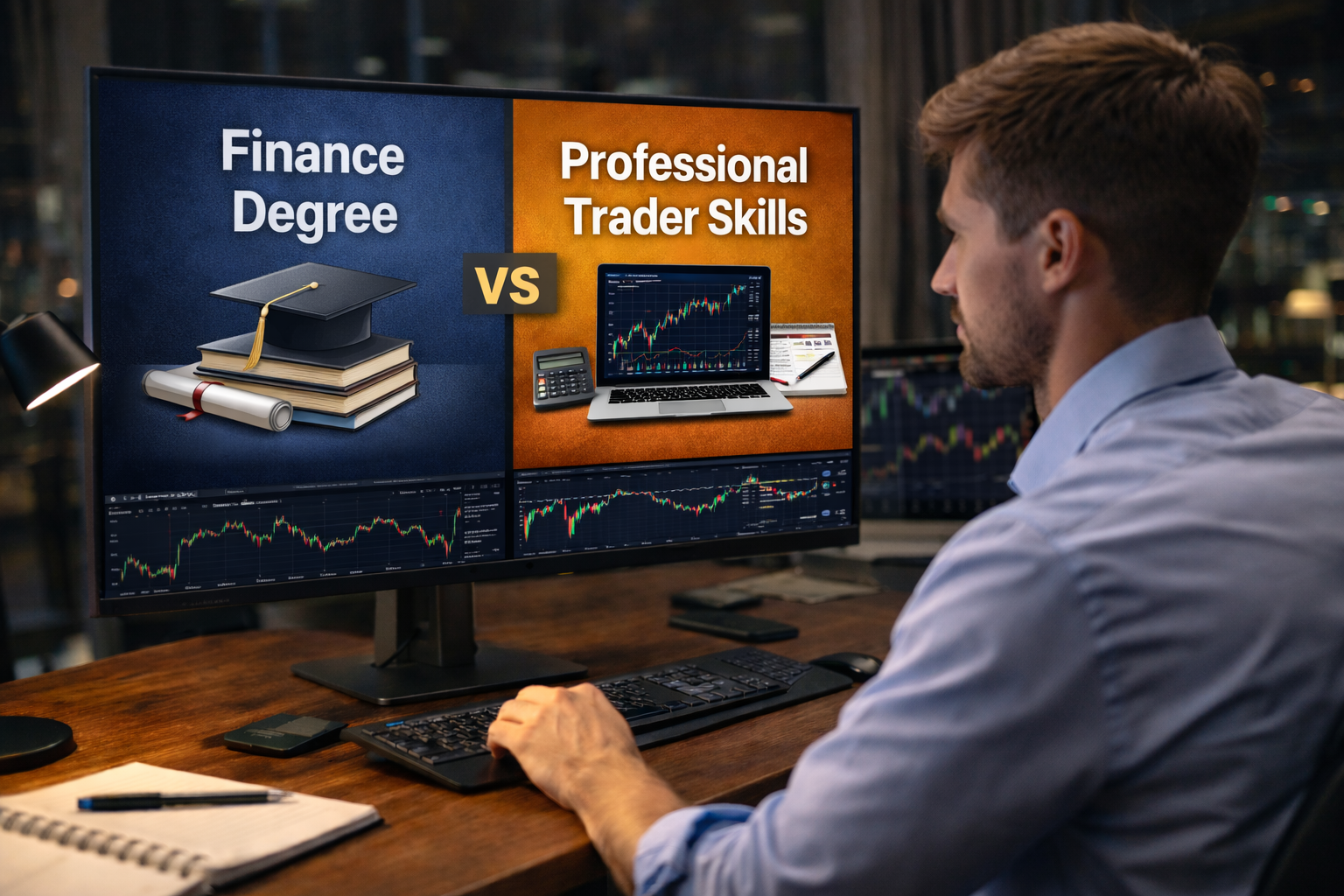
Do you need a finance degree to become a professional trader is a question asked by people who want a realistic entry path into trading without unnecessary academic barriers. This article explains whether a finance degree is required, what skills matter most in professional trading, and how traders without academic finance backgrounds develop consistent, professional-level competence. It is written for serious individuals evaluating trading as a career rather than a short-term activity.
A finance degree is not required to become a professional trader, but structured trading education, analytical skill, and disciplined risk management are essential.
What Professional Trading Actually Requires
Professional trading is not defined by academic qualifications. It is defined by consistent decision-making, controlled risk, and the ability to operate effectively across changing market conditions.
Professional traders analyse uncertainty, manage downside risk, and execute within defined processes. These abilities are developed through education and deliberate practice rather than formal degrees.
Understanding this distinction explains why credentials and trading performance are not directly correlated.
What a Finance Degree Does and Does Not Teach
A finance degree focuses primarily on theory. It covers financial markets, valuation models, accounting concepts, and economic frameworks.
However, most finance degrees do not teach real-time decision-making, execution under uncertainty, or psychological discipline. Trading requires applying information dynamically while managing risk and emotional pressure.
As a result, a finance degree alone does not prepare someone to trade professionally.
Why Many Professional Traders Do Not Have Finance Degrees
Many professional traders come from engineering, mathematics, economics, science, or non-finance professional backgrounds. These individuals often perform well because they bring analytical thinking, structured problem-solving, and process discipline.
Trading rewards evidence-based reasoning and adaptability more than memorised theory. Therefore, transferable skills often matter more than academic specialisation.
This explains why professional trading environments historically recruited from diverse academic backgrounds.
Finance Degree vs Professional Trading Skills: What Matters Most
A clear comparison helps clarify priorities.
A finance degree emphasises theoretical knowledge and academic assessment.
Professional trading emphasises applied decision-making and behavioural discipline.
Degrees test understanding through exams, while trading tests performance through risk control and consistency.
Academic study rewards correctness, while trading rewards probabilistic thinking and adaptability.
Professional trading skills, not academic credentials, determine long-term success.
The Skills That Matter More Than a Finance Degree
Analytical Thinking
Professional traders evaluate probabilities and scenarios rather than seek certainty. Analytical reasoning allows traders to interpret data objectively and avoid emotional bias.
Risk Management Discipline
Risk management defines professional trading. Position sizing, drawdown control, and capital preservation determine survivability and learning longevity.
Decision-Making Under Uncertainty
Markets operate under incomplete information. Traders must make decisions without certainty and accept imperfect outcomes consistently.
Psychological Control
Emotional discipline prevents impulsive behaviour. Managing stress, bias, and overconfidence supports stable decision-making over time.
How Traders Without Finance Degrees Learn Professionally
Traders without finance degrees typically follow structured professional trading education rather than academic pathways. This education focuses on how markets function in practice, not just in theory.
Professional trading education integrates macroeconomics, market structure, technical frameworks, risk management, and psychology into a unified decision process. This mirrors institutional training more closely than university study.
Mentoring and structured feedback often accelerate development by correcting interpretation errors early.
When a Finance Degree Can Be Helpful
A finance degree can be helpful but is not necessary. It may provide familiarity with economic concepts, financial terminology, and market structure.
However, these advantages are incremental rather than decisive. Without structured trading education and disciplined practice, a finance degree alone does not lead to professional trading competence.
Common Misconceptions About Degrees and Trading
One misconception is that trading success depends on academic credentials. In reality, trading rewards behaviour, process, and discipline.
Another misconception is that degrees guarantee credibility. Professional trading credibility comes from consistency, risk control, and decision quality, not qualifications.
Recognising these misconceptions prevents misplaced confidence.
Education Pathways for Aspiring Professional Traders
Aspiring professional traders benefit most from education that teaches applied decision-making rather than academic theory alone.
Structured professional trading education focuses on real-world analysis, risk management, review, and continuous improvement. This pathway remains accessible regardless of academic background.
Choosing education aligned with professional trading standards improves long-term outcomes.
Is a Finance Degree Worth It for Trading
A finance degree can be valuable for broader finance careers, but it is not a requirement for trading professionally.
For individuals focused specifically on trading, targeted professional trading education often delivers higher relevance and efficiency than academic study.
The decision should be based on career goals rather than assumptions about trading ability.
Frequently Asked Questions
Do you need a finance degree to become a professional trader
A finance degree is not required to become a professional trader. Professional trading depends on structured education, disciplined risk management, and consistent decision-making rather than formal academic qualifications.
Can you become a trader without a degree
You can become a trader without a degree if you develop strong analytical skills, risk management discipline, and structured decision-making processes through professional trading education and practice.
Does a finance degree improve trading performance
A finance degree may improve theoretical understanding, but it does not guarantee better trading performance. Practical skill, behavioural discipline, and risk control matter far more for long-term consistency.
What education is best for traders without finance degrees
Structured professional trading education that focuses on market analysis, risk management, and trading psychology is most effective for traders without academic finance backgrounds.
Should beginners study finance or trading first
Beginners focused on trading usually benefit more from structured trading education than academic finance study, as it teaches applied decision-making and risk control rather than theory alone.