
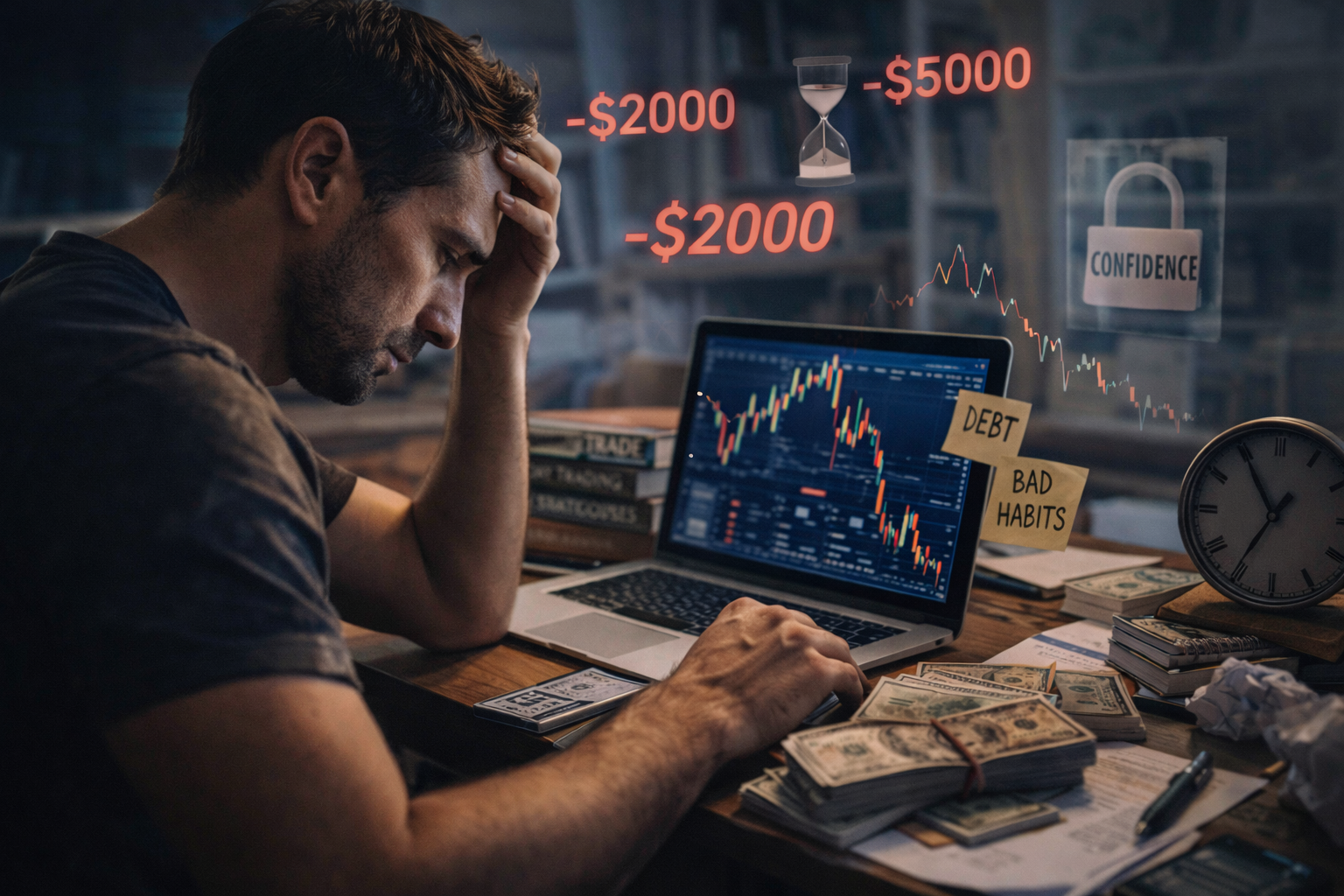
The Real Cost of Learning to Trade the Wrong Way
Learning to trade the wrong way carries costs that go far beyond losing trades. This article explains the true financial, psychological, and opportunity costs of poor trading education, why these costs compound over time, and how incorrect learning paths delay or permanently damage long-term trading development. It is written for serious learners reassessing their approach before committing more time and capital.
The true cost of learning to trade the wrong way is not losses alone, but the compounding damage to capital, confidence, decision-making quality, and time.
The Real Cost of Learning to Trade the Wrong Way: At a Glance
The most damaging costs are rarely obvious at the start:
- Capital erosion: repeated losses and occasional large drawdowns
- Wasted years: time spent repeating the same mistakes without progress
- Psychological burnout: loss of confidence, emotional fatigue, and frustration
- Bad habits: behaviours that must be unlearned before improvement can begin
- Lost opportunity: delayed compounding of professional-level skills
Together, these costs often exceed the visible losses in a trading account.
The Hidden Cost Most Traders Ignore
Many traders measure cost only in account drawdowns. However, the larger cost is cumulative and structural.
Poor education teaches incorrect habits. Over time, these habits become embedded and harder to remove, even when better information becomes available. This creates a persistent drag on performance that lasts far longer than any single loss.
Financial Cost Goes Beyond Losing Trades
Repeated small losses can appear manageable. Yet weak risk education frequently leads to occasional large losses that erase months or years of progress.
In addition, traders often pay repeatedly for education. They move from one course to another, searching for fixes instead of correcting foundations. The total financial outlay quietly escalates.
The real financial cost is capital erosion combined with repeated educational spending.
Psychological Damage Accumulates
Learning the wrong way undermines confidence. Traders begin to doubt their ability to analyse markets and execute decisions calmly.
Each failure reinforces frustration. Over time, emotional fatigue replaces discipline and curiosity. This psychological damage reduces the ability to follow any process, even when a better one is introduced.
Psychological burnout is one of the most common reasons traders abandon trading entirely.
Time Is the Most Expensive Currency
Time lost to ineffective learning cannot be recovered. Many traders spend years repeating the same errors because education never addresses root causes.
Incorrect learning paths delay skill development. Even motivated learners stagnate when structure, feedback, and professional standards are missing.
For serious traders, wasted time represents lost compounding, lost opportunity, and delayed competence.
Bad Habits Become Hard to Remove
Poor trading education often rewards impulsive behaviour, overtrading, or outcome fixation.
Once these habits are ingrained, correcting them requires significant effort. Traders must first unlearn behaviour before building a professional process.
This unlearning phase carries a high cognitive and emotional cost that is rarely discussed.
Opportunity Cost Is Rarely Considered
While traders pursue shortcuts, they miss opportunities to build transferable skills.
Structured education develops analytical reasoning, risk assessment, and disciplined decision-making. These skills compound across markets, instruments, and economic cycles.
The opportunity cost of not developing them early is substantial.
Why Cheap Education Often Becomes Expensive
Low-cost courses appear attractive initially. However, when they fail to produce consistency, traders pay again for new material.
Each restart resets progress. Over time, the total cost of cheap education frequently exceeds the cost of professional training taken earlier.
Value should be measured by durability and outcomes, not price.
The Cost of Delayed Professional Standards
Professional trading standards emphasise process, risk control, and review. When these standards are introduced late, traders must rebuild from unstable foundations.
Early exposure to professional frameworks reduces correction costs later. Delayed standards increase the total cost of learning significantly.
What Correct Education Actually Saves
Correct education saves capital by controlling downside risk. It saves time by accelerating learning curves. It saves psychological energy by replacing uncertainty with structure.
Most importantly, it preserves optionality. Traders remain capable of improving instead of burning out.
How to Avoid Paying the Wrong Price
Traders should evaluate education based on structure, risk depth, decision frameworks, and realism.
Courses should explain why decisions are made, not just how to enter trades. They should also set honest timelines and include review mechanisms.
Choosing correctly early reduces total cost dramatically.
Frequently Asked Questions
What is the real cost of learning to trade the wrong way
The real cost includes capital losses, wasted years, psychological fatigue, and the difficulty of unlearning bad habits. These costs compound over time and often exceed visible account losses, delaying or preventing long-term trading consistency.
Can bad trading education permanently harm performance
Bad trading education can significantly delay performance by embedding poor habits and emotional responses. While recovery is possible, traders often must unlearn behaviour before improving, which increases total learning time and psychological strain.
Why do traders keep buying new trading courses
Traders often buy new courses because earlier education failed to address process, risk management, or decision-making. Without fixing root causes, learners search for new solutions instead of correcting unstable foundations.
Is cheap trading education a false economy
Cheap trading education frequently becomes expensive when it fails to produce consistency. Traders often spend more over time replacing ineffective courses than they would investing in structured, professional education earlier.
How can traders reduce the cost of learning to trade
Traders reduce cost by choosing education that teaches process-led decision-making, professional risk management, adaptable frameworks, and realistic timelines from the beginning, rather than relying on shortcuts or profit promises.