
What Professional Traders Learn That Retail Traders Don’t
Professional traders and retail traders are exposed to very different forms of learning. This article explains what professional traders are taught that retail traders usually are not, why these differences matter for long-term consistency, and how professional education reshapes decision-making, risk control, and performance over time. It is written for serious learners questioning whether retail-level knowledge is holding them back.
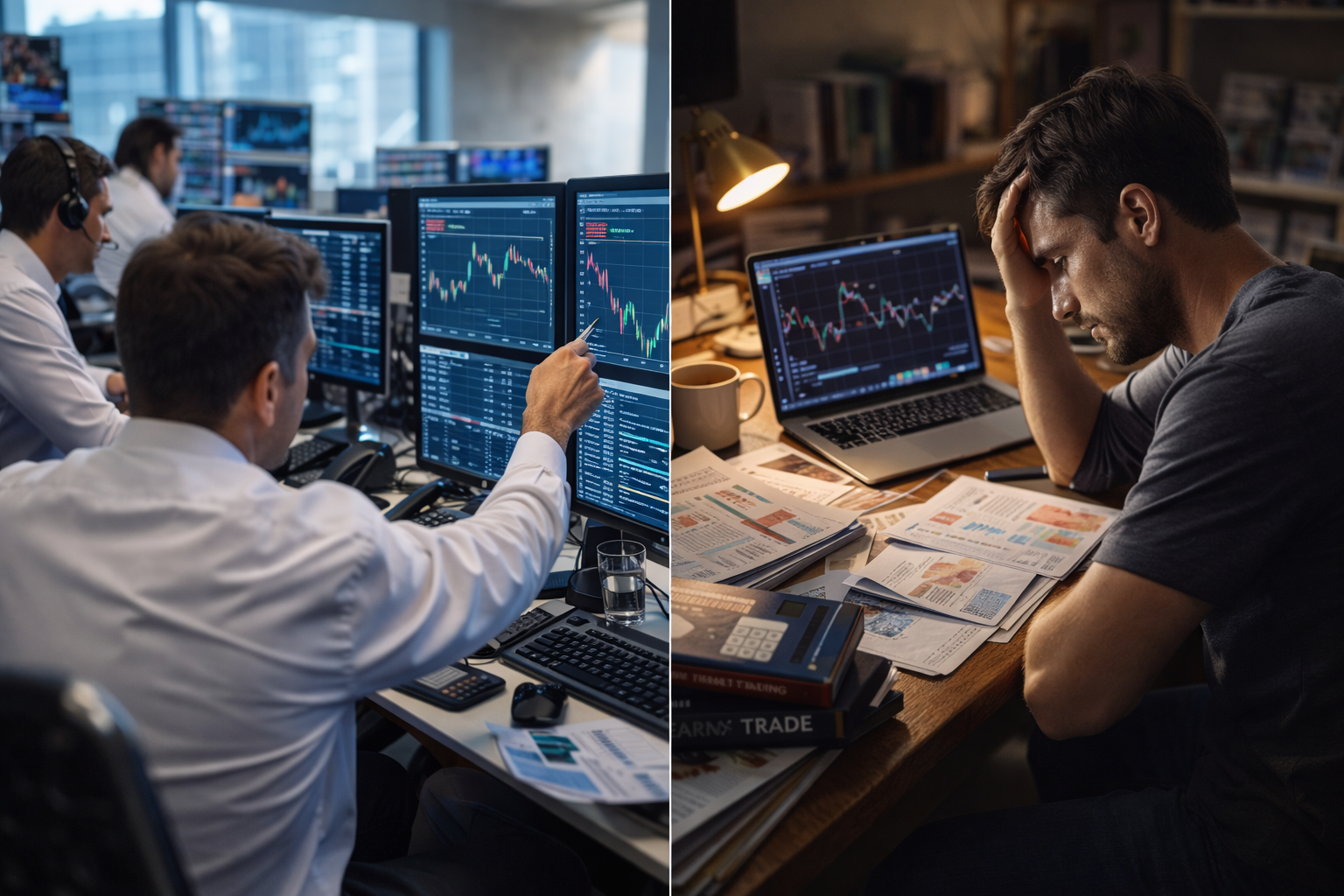
Professional traders are taught process, risk discipline, and decision-making frameworks, while retail traders are usually taught tactics, tools, and outcomes.
What Professional Traders Learn vs What Retail Traders Are Taught
The differences are structural and decisive:
- Process vs setups: professionals learn a repeatable workflow; retail traders learn isolated strategies
- Risk first vs entries first: professionals control downside before opportunity; retail traders chase signals
- Probabilistic thinking vs certainty seeking: professionals accept uncertainty; retail traders look for confirmation
- Context vs indicators: professionals read market context; retail traders apply tools in isolation
- Review vs outcome obsession: professionals audit decisions; retail traders fixate on wins and losses
These contrasts explain why performance diverges over time.
Professional Trading Is Taught as a Process, Not a Strategy
Professional traders learn that trading is a repeatable process rather than a collection of setups. Education focuses on analysing conditions, assessing risk, executing decisions, and reviewing outcomes within a structured workflow.
Retail traders are often taught isolated strategies. When those strategies fail, there is no underlying process to adapt or recover. Process-based learning allows professionals to remain consistent even as markets change.
Risk Is Taught as the Core Skill
Professional traders are trained to think about risk before opportunity. Position sizing, drawdown control, and capital preservation are treated as primary skills, not optional add-ons.
Retail education frequently treats risk management as a secondary topic. As a result, many retail traders survive only while conditions are favourable. Professionals remain solvent because risk discipline is embedded from the start.
Decision-Making Under Uncertainty Is Explicitly Taught
Markets operate under uncertainty, and professional traders are trained to accept this reality. They learn probabilistic thinking, scenario assessment, and how to act without certainty.
Retail traders are often taught to seek confirmation or signals. This increases hesitation, emotional stress, and inconsistency. Professional education replaces certainty-seeking with structured judgement.
Context Matters More Than Indicators
Professional traders learn to interpret context. They assess macro conditions, market structure, liquidity, and sentiment before applying technical tools.
Retail traders are frequently taught to apply indicators without context. This works intermittently but breaks down when regimes change. Contextual understanding is one of the biggest performance differentiators.
Review and Feedback Are Non-Negotiable
Professional traders are trained to review decisions objectively. They evaluate whether trades followed process rather than focusing solely on profit or loss.
Retail traders often review emotionally or not at all. Without structured review, mistakes repeat. Feedback loops drive continuous improvement and accountability.
Psychology Is Treated as a Skill, Not a Trait
Professional traders are taught that psychology can be trained. Emotional discipline, bias awareness, and stress management are developed deliberately within the system.
Retail education often frames psychology as something traders either have or lack. Professional learning treats psychology as a skill that improves with structure and practice.
Adaptability Is Prioritised Over Certainty
Professional traders are taught to adapt. They expect market behaviour to change and build flexibility into their frameworks.
Retail traders often expect methods to keep working. When they don’t, confidence collapses. Adaptability protects consistency over time.
Standards Are Set Higher From the Beginning
Professional traders operate to defined standards governing preparation, execution, risk, and review. These benchmarks make progress measurable and errors visible.
Retail traders often operate without standards. Without benchmarks, development stalls. High standards accelerate learning and reduce noise.
Why Retail Traders Rarely Learn These Skills
Retail education is often designed to sell quickly rather than develop skill. Teaching process, risk, and discipline requires time, structure, and realism.
As a result, many retail traders never encounter professional frameworks unless they actively seek them out. The gap is educational, not intellectual.
Bridging the Education Gap
Retail traders can learn professional skills by choosing education that teaches process, risk discipline, decision frameworks, and realistic timelines.
The transition requires abandoning shortcut thinking and adopting professional standards. Those who make this shift dramatically improve consistency and confidence.
Frequently Asked Questions
What do professional traders learn that retail traders don’t
Professional traders learn structured process, disciplined risk management, probabilistic decision-making, and objective review. Retail traders are usually taught strategies, indicators, and short-term tactics, which do not build adaptable, long-term consistency.
Is professional trading education harder than retail education
Professional trading education is more demanding because it focuses on discipline, process, and long-term development. However, it reduces repeated mistakes and resets by building durable skills from the start.
Can retail traders learn professional trading skills
Retail traders can learn professional trading skills by adopting structured education that prioritises risk control, decision frameworks, context, and realistic expectations rather than shortcuts or signals.
Why do retail traders struggle with consistency
Retail traders often struggle with consistency because education emphasises outcomes and tools instead of process, adaptability, and risk discipline, which are required to navigate changing market conditions.
Does professional trading education take longer
Professional trading education typically takes longer initially, but it often reduces total learning time by avoiding repeated failures, rebuilding, and psychological burnout associated with retail-level approaches.