
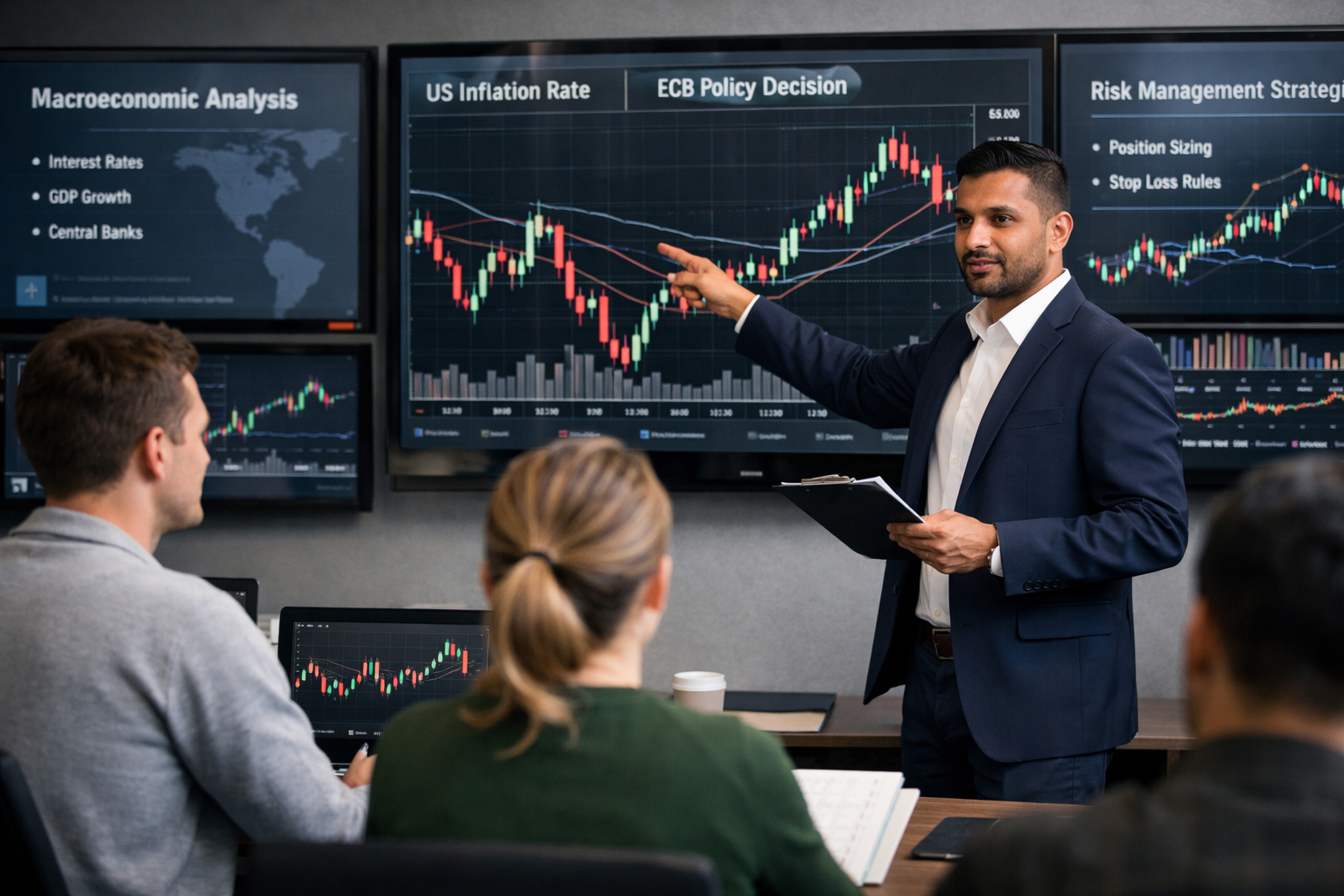
Best Professional Trading Course in 2026
Introduction
Best professional trading course in 2026 searches come from serious individuals who want structured, credible trading education rather than shortcuts, signals, or speculation. This article explains what defines a genuinely professional trading course, how institutional-standard programmes differ from retail offerings, and how to choose education that supports long-term consistency across market cycles. It is written for aspiring professional traders, career-switchers, and experienced traders seeking postgraduate-level trading education built for real-world markets.
A professional trading course is a structured, process-led education programme that teaches market analysis, risk management, execution, and disciplined decision-making using institutional-grade frameworks rather than retail strategies or signals.
What Makes a Trading Course “Professional” in 2026
A professional trading course focuses on structure, depth, and skills that transfer across markets. In 2026, professional trading education explains how markets work as systems, not how to trade a single setup.
Instead of chasing short-term performance, professional programmes develop repeatable analysis, disciplined risk control, and consistent decision-making. As a result, traders learn to adapt as market conditions change.
Most importantly, professional education prioritises longevity and capital protection over excitement or fast results.
How to Identify the Best Professional Trading Course
The best professional trading course does not rely on bold promises or marketing claims. Instead, it meets clear educational standards.
A high-quality course teaches macroeconomic context, market structure, technical frameworks, formal risk management, and trading psychology in an integrated way. Therefore, it trains traders how to think, analyse, and adapt rather than what to trade.
When a course follows institutional standards, it focuses on process over prediction and education over dependency.
Institutional Trading Education vs Retail Trading Courses
Retail trading courses usually focus on indicators, simplified strategies, or rigid rules. In contrast, professional trading courses use a very different approach.
Institutional-style education trains traders to analyse macroeconomic data, central bank policy, liquidity conditions, and risk sentiment. For example, institutions such as the Federal Reserve, European Central Bank, IMF, and BIS influence markets through policy decisions and economic cycles.
Because of this, professional education teaches traders how to interpret these drivers and apply them within a structured framework.
Core Skills Taught in a Professional Trading Course
Macroeconomic and Fundamental Analysis
Professional traders learn how inflation, interest rates, economic growth, labour markets, and central bank policy influence asset prices. They study how to interpret data releases, policy statements, and macro trends across full economic cycles.
As a result, this skillset supports professional trading in forex, stocks, indices, gold, and other macro-driven markets.
Market Structure and Technical Frameworks
Professional trading courses teach technical analysis as a contextual tool, not a shortcut. Traders focus on structure, trend, liquidity, and multi-timeframe alignment instead of relying on indicators.
Therefore, technical analysis supports execution within a broader analytical process.
Risk Management and Capital Protection
Professional trading education treats risk management as a core discipline. Courses teach position sizing, drawdown control, expectancy, and capital protection as essential skills.
Because of this focus, traders can stay operational during difficult market periods.
Trading Psychology and Decision Discipline
Professional trading courses address behavioural risk directly. Traders develop emotional control, bias awareness, and decision discipline through structured processes.
Consequently, psychology supports consistency rather than becoming a hidden source of risk.
Professional Trading Course vs Trading Mentorship
A professional trading course provides structure, theory, and analytical frameworks. Mentoring, however, accelerates learning through feedback and accountability.
The strongest programmes combine structured education with one-to-one mentoring. This approach mirrors institutional training, where learning combines formal curriculum with guided application.
Who a Professional Trading Course Is Designed For
Professional trading courses suit individuals who treat trading as a serious skill rather than a hobby. This group includes career-switchers, finance professionals, analysts, and experienced traders seeking structured improvement.
However, these courses do not suit people looking for signals, shortcuts, or guaranteed outcomes.
Applied Professional Trading at Masters Level
The Masters in Applied Professional Trading (MBA) at Traders MBA delivers postgraduate-level trading education built around institutional standards. The programme integrates macroeconomics, market structure, technical analysis, execution, risk management, and trading psychology into one process-led framework.
As a result, traders develop disciplined thinking and consistency across market environments. For those who want direct guidance, the mentoring pathway adds structured one-to-one sessions to reinforce correct interpretation and learning continuity.
Related learning paths include applied professional forex trading, applied professional stock trading, and structured risk management education.
Common Mistakes When Choosing a Trading Course
Many traders choose courses based on marketing rather than depth. Short programmes that focus only on indicators or strategies often fail when market conditions change.
Another common mistake involves ignoring risk management and psychology. Without these skills, even strong analysis leads to unstable results. Professional trading education avoids this by prioritising discipline and adaptability.
Example of a Professional Trading Approach
When a professional trader analyses EUR/USD, they do not rely only on chart patterns. Instead, they assess Federal Reserve and ECB policy direction, inflation trends, growth momentum, and global risk sentiment.
Next, they use technical analysis to time execution within the broader macro view. Finally, they size risk based on volatility, portfolio exposure, and capital rules rather than conviction alone.
Professional trading courses teach this structured process step by step.
Choosing the Best Professional Trading Course in 2026
The best professional trading course in 2026 teaches transferable skills, structured analysis, and disciplined risk management. It develops independent thinking instead of reliance on tools or predictions.
Therefore, institutional-standard programmes that integrate macroeconomics, technical frameworks, psychology, and risk management provide the strongest foundation for long-term professional trading development.
Frequently Asked Questions
What is the best professional trading course in 2026
The best professional trading course in 2026 teaches structured analysis, macroeconomic context, disciplined risk management, and consistent decision-making using institutional-style frameworks rather than isolated strategies or signals. Courses that combine theory with practical application deliver the strongest long-term educational value.
Are professional trading courses suitable for beginners
Professional trading courses can suit serious beginners who want to learn correctly from the start. These programmes focus on clear foundations, structured thinking, and disciplined habits, which helps learners avoid common mistakes linked to unstructured retail trading education.
Is trading education better than trading signals
Trading education builds independent analytical skills and flexibility across market conditions. In contrast, trading signals create dependency and limit understanding. For this reason, professional traders rely on education, probability, and risk control rather than external predictions.
Do professional trading courses include mentoring
Some professional trading courses include integrated mentoring. Mentoring speeds up learning by providing feedback, accountability, and guided interpretation, which closely reflects institutional training environments used in banks and asset management firms.
Can trading realistically become a profession
Trading can become a profession when traders follow structured education, disciplined processes, and strong risk management. Professional trading focuses on consistency and capital protection instead of short-term gains, which makes high-quality education essential.