
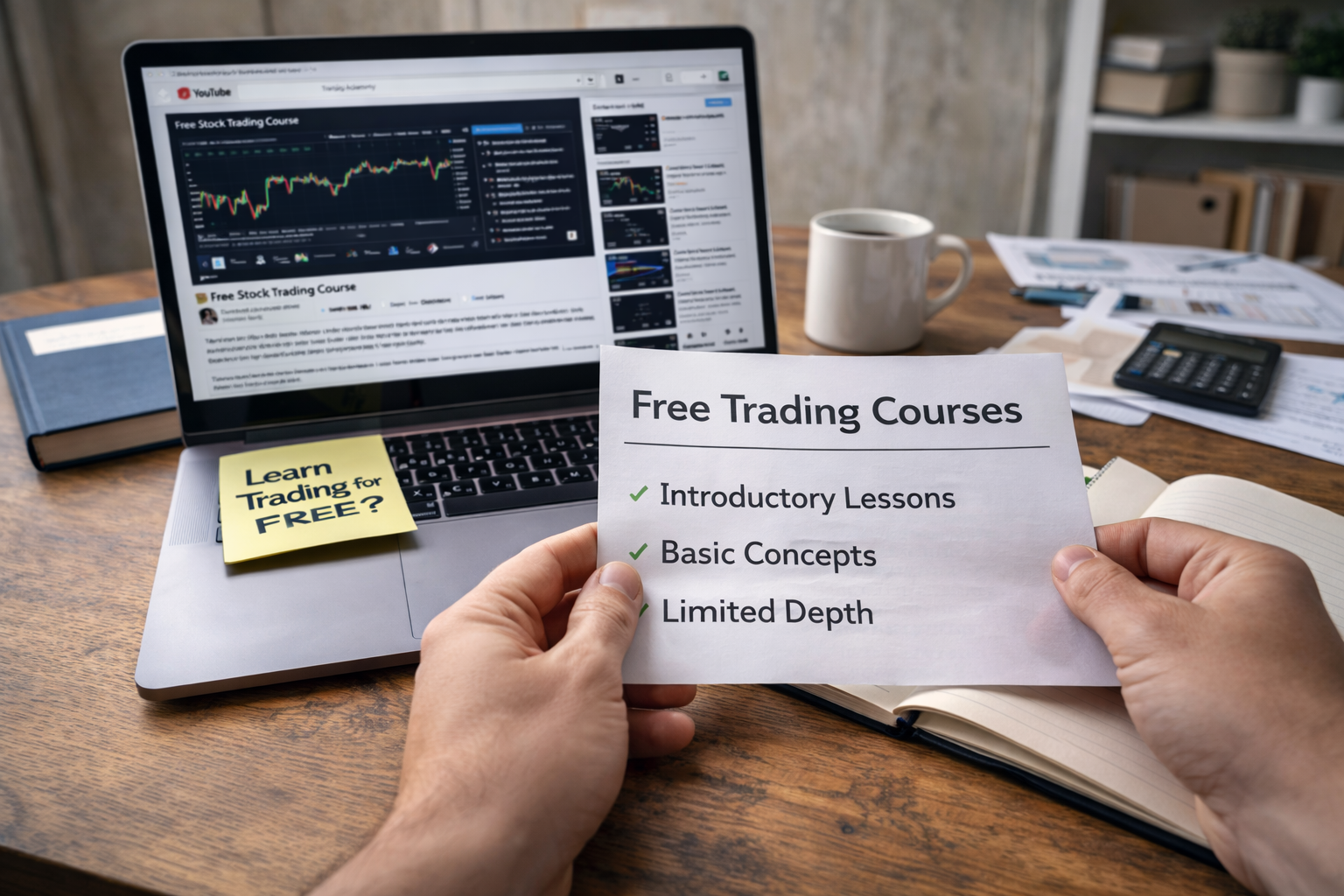
Free Trading Courses: What You Can (and Can’t) Learn for Free
Free trading courses attract beginners who want to learn trading without financial commitment. They promise access to trading education, market concepts, and sometimes even “complete” systems at no cost. This article explains what free trading courses genuinely teach, where their limits lie, and how to use free resources effectively without developing false expectations.
Free trading courses are educational resources that introduce trading concepts at no cost, but they are limited in structure, depth, feedback, and skill development compared with structured learning pathways.
What Free Trading Courses Typically Cover
Most free trading courses focus on foundational knowledge. They are designed to introduce terminology, market structure, and basic trading concepts rather than develop advanced decision-making skill.
Common topics include:
- What financial markets are and how trading works
- Basic order types and platform navigation
- Introductory technical or fundamental concepts
- General risk awareness
These courses are useful for orientation, not mastery.
Types of Free Trading Courses Available
Free trading education usually falls into a few categories.
Platform-Based Free Courses
Broker platforms and financial websites often provide free trading courses as onboarding material. These explain markets and tools but rarely go beyond surface-level education.
Video-Based Free Trading Courses
Short video series or recorded lessons introduce trading ideas visually. While accessible, they are often fragmented and lack progression.
Text-Based Free Learning Resources
Articles, guides, and PDFs can explain concepts clearly but rely heavily on self-discipline and independent study.
Each format can help beginners understand basics but requires careful selection.
What Free Trading Courses Do Well
Free trading courses offer several advantages:
- Low barrier to entry
- Exposure to trading language and concepts
- Opportunity to explore interest before committing
- Useful reference material for beginners
They are especially helpful for confirming whether trading is an area worth deeper study.
What Free Trading Courses Cannot Provide
Despite their value, free trading courses have clear limitations.
They usually do not provide:
- Structured skill progression
- Personal feedback or accountability
- Context for decision-making under uncertainty
- Long-term performance review
Learning trading requires more than information. Skill develops through guided practice and review, which free resources rarely offer.
Why Many Learners Stall Using Only Free Courses
A common pattern is consuming large amounts of free content without improvement. This happens because:
- Learning lacks structure
- Concepts are not applied consistently
- There is no feedback loop
- Progress is not measured
Information alone does not translate into trading skill.
How to Use Free Trading Courses Effectively
Free trading courses work best when used strategically.
Effective use includes:
- Using free courses for orientation and vocabulary
- Combining multiple resources into a simple framework
- Practising concepts in a controlled environment
- Reviewing outcomes and refining understanding
Free education should support learning, not replace structure.
Free vs Paid Trading Courses: A Practical Comparison
Free courses introduce concepts. Paid courses usually organise learning into a progression. Neither guarantees results, but structured learning often reduces confusion.
The key difference is not price, but design:
- Free courses explain “what”
- Structured courses focus more on “how” and “why”
Understanding this distinction helps set realistic expectations.
Common Mistakes When Relying on Free Trading Courses
Learners often make avoidable mistakes:
- Expecting free courses to create consistency
- Jumping between unrelated resources
- Mistaking information consumption for skill
- Avoiding practice and review
Avoiding these mistakes matters more than choosing any specific resource.
Are Free Trading Courses Enough for Beginners?
Free trading courses are sufficient for learning basics. They are rarely sufficient for developing reliable trading behaviour.
Most learners eventually need:
- A structured learning path
- Clear rules and repetition
- Feedback and performance review
Free education is a starting point, not a complete solution.
Frequently Asked Questions
Are free trading courses worth using?
Free trading courses are useful for learning basic concepts and understanding how trading works. They are best used as an introduction rather than a complete learning solution.
Can you become a trader using only free trading courses?
It is possible to learn fundamentals using free resources, but most people struggle to develop consistent skill without structure, feedback, and guided practice.
What is the best free trading course for beginners?
There is no single best free trading course. Beginners benefit most from using a small number of well-structured resources rather than consuming large volumes of disconnected content.
Do free trading courses teach real trading skills?
Free courses teach concepts and definitions. Real trading skill develops through practice, review, and disciplined application over time.
How should beginners combine free trading courses with practice?
Beginners should use free courses to learn basics, then practise applying concepts in a controlled way while reviewing decisions and outcomes regularly.