
How Long Does It Take to Become a Professional Trader?
How long does it take to become a professional trader is a question asked by people who want realistic answers, not marketing promises. This article explains the true timeline to professional trading, the stages traders move through, and the factors that speed up or slow down progress. It is written for aspiring professional traders who want structure, clarity, and long-term consistency rather than shortcuts.
Becoming a professional trader typically takes several years of structured education, disciplined practice, and consistent risk management across different market conditions.
What “Becoming a Professional Trader” Actually Means
Professional trading is defined by behaviour, not income targets. A professional trader demonstrates consistency, disciplined risk control, and repeatable decision-making across full market cycles.
Instead of chasing short-term gains, professional traders focus on process quality, capital preservation, and adaptability. Because of this, progress is measured by stability and survivability rather than isolated winning periods.
Understanding this definition is essential before assessing timelines.
Why Trading Takes Longer Than Most People Expect
Trading combines macroeconomics, probability, behaviour, and risk under constant uncertainty. As a result, progress is rarely linear.
Unlike traditional careers with predictable promotion paths, trading development includes setbacks, learning plateaus, and periods of recalibration. Therefore, time alone does not create competence. Structured education and deliberate practice matter far more.
Professional traders accept this early, which helps them avoid frustration-driven mistakes.
The Professional Trader Timeline (Realistic Overview)
While individual paths differ, most professional traders progress through similar stages.
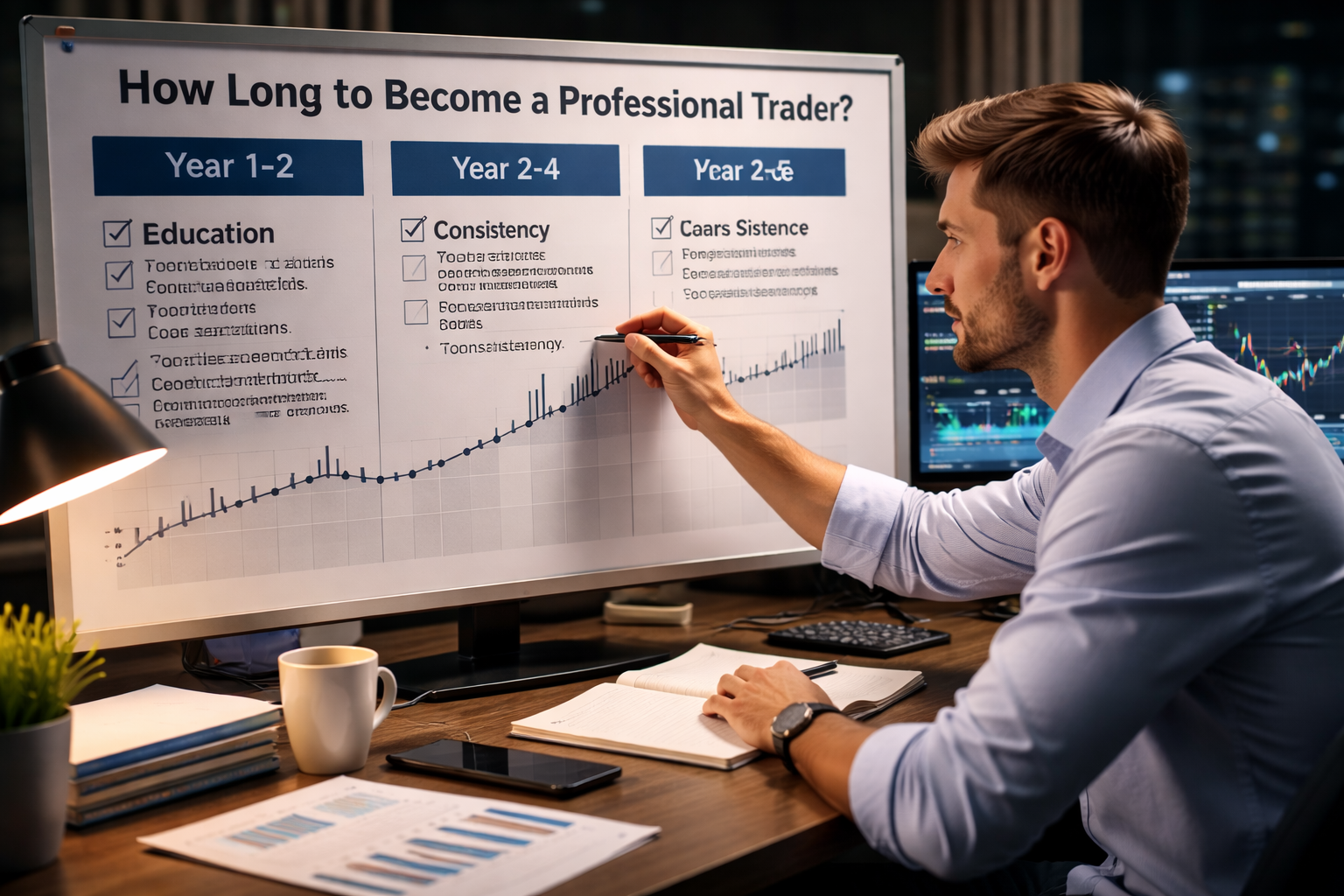
Years 1–2: Education and Foundation
The first stage focuses on education. Traders learn how markets function, how prices respond to macroeconomic forces, and how risk should be managed.
Professional education covers macroeconomic drivers, market structure, technical frameworks, risk management, and trading psychology. At this stage, performance is not the goal. Understanding and discipline come first.
This phase typically lasts one to two years when approached seriously.
Years 2–4: Structured Practice and Process Building
The second stage focuses on application. Traders begin applying frameworks in live market conditions while keeping risk tightly controlled.
Mistakes occur frequently. However, structured review, journaling, and feedback turn errors into progress. Because of this, learning accelerates during this phase.
This stage often takes another one to two years, depending on education quality and discipline.
Years 3–5: Consistency and Professional Behaviour
The third stage marks the emergence of professional characteristics. Traders show consistent decision-making, controlled drawdowns, and stable behaviour across different environments.
At this point, outcomes become more predictable, although never guaranteed. Capital preservation remains the priority.
Many traders reach this stage after three to five years of structured development.
Factors That Speed Up or Slow Down Progress
Quality of Trading Education
High-quality, structured trading education shortens the learning curve by providing correct frameworks early. Courses that teach process, risk control, and adaptability outperform those focused on isolated strategies.
Poor education often leads to repeated mistakes and extended timelines.
Risk Management Discipline
Risk management determines survival. Traders who control position size and drawdowns remain active long enough to improve.
Although risk management does not increase short-term profits, it accelerates learning by preserving capital and confidence.
Feedback and Mentorship
Feedback accelerates progress. Mentorship helps traders identify blind spots, correct interpretation errors, and maintain discipline.
Without feedback, traders often repeat the same mistakes for years.
Psychological Discipline
Emotional control strongly influences timelines. Traders who manage expectations, stress, and bias progress more smoothly than those driven by urgency or frustration.
Can Someone Become a Professional Trader Faster
Some traders progress faster than average, but this is uncommon. Faster development usually occurs when traders combine structured education, disciplined risk control, and high-quality feedback.
Even then, professional competence still requires time across different market conditions. Claims of rapid mastery usually reflect marketing rather than reality.
Trading Full-Time vs Trading Professionally
Trading full-time does not automatically mean trading professionally. Many full-time traders lack consistency and structured processes.
Professional trading prioritises decision quality and capital preservation first. Income becomes a by-product of disciplined execution rather than the objective.
Understanding this distinction prevents premature career decisions.
Common Mistakes That Delay Professional Development
One common mistake is frequent strategy switching, which prevents deep learning.
Another mistake is increasing risk too early. Large drawdowns often reset progress completely.
Finally, many traders avoid honest review. Without structured reflection, errors persist.
Professional traders actively avoid these behaviours.
Is the Time Investment Worth It
For individuals who value independence, analytical work, and long-term skill development, trading can become a rewarding profession.
However, it is not suitable for those seeking fast income or certainty. Professional trading rewards patience, discipline, and structured thinking over time.
Frequently Asked Questions
How long does it take to become a professional trader
Becoming a professional trader usually takes several years. Most serious traders require three to five years of structured education, disciplined practice, and strong risk management before demonstrating consistent professional behaviour across market cycles.
Can you become a professional trader in one year
Becoming a professional trader in one year is highly unlikely. While basic concepts can be learned quickly, consistency, discipline, and risk control develop only through experience across multiple market conditions.
Does education reduce the time needed to become professional
High-quality trading education can reduce wasted time by providing structure and correct frameworks early. However, education cannot remove the need for disciplined practice and real-market experience.
Is mentorship necessary to speed up progress
Mentorship is not essential, but it often accelerates progress. Structured feedback helps traders identify errors early and avoid repeating mistakes that can delay development for years.
When should a trader consider trading full-time
Traders should consider full-time trading only after demonstrating consistent behaviour, controlled drawdowns, and disciplined decision-making over a prolonged period rather than after short-term profitability.