
How to Tell If a Trading Course Is Actually Worth Paying For
Choosing a trading course is a high-stakes decision for serious traders. This article explains how to evaluate whether a trading course is genuinely worth paying for, how to separate professional education from marketing-driven content, and what signals indicate a course is designed to build durable trading skill rather than sell short-term promises. It is written for traders who want to invest once, correctly, and avoid wasting time or capital.
A trading course is worth paying for only if it teaches process, professional risk discipline, and decision-making standards that remain valid across changing market conditions.
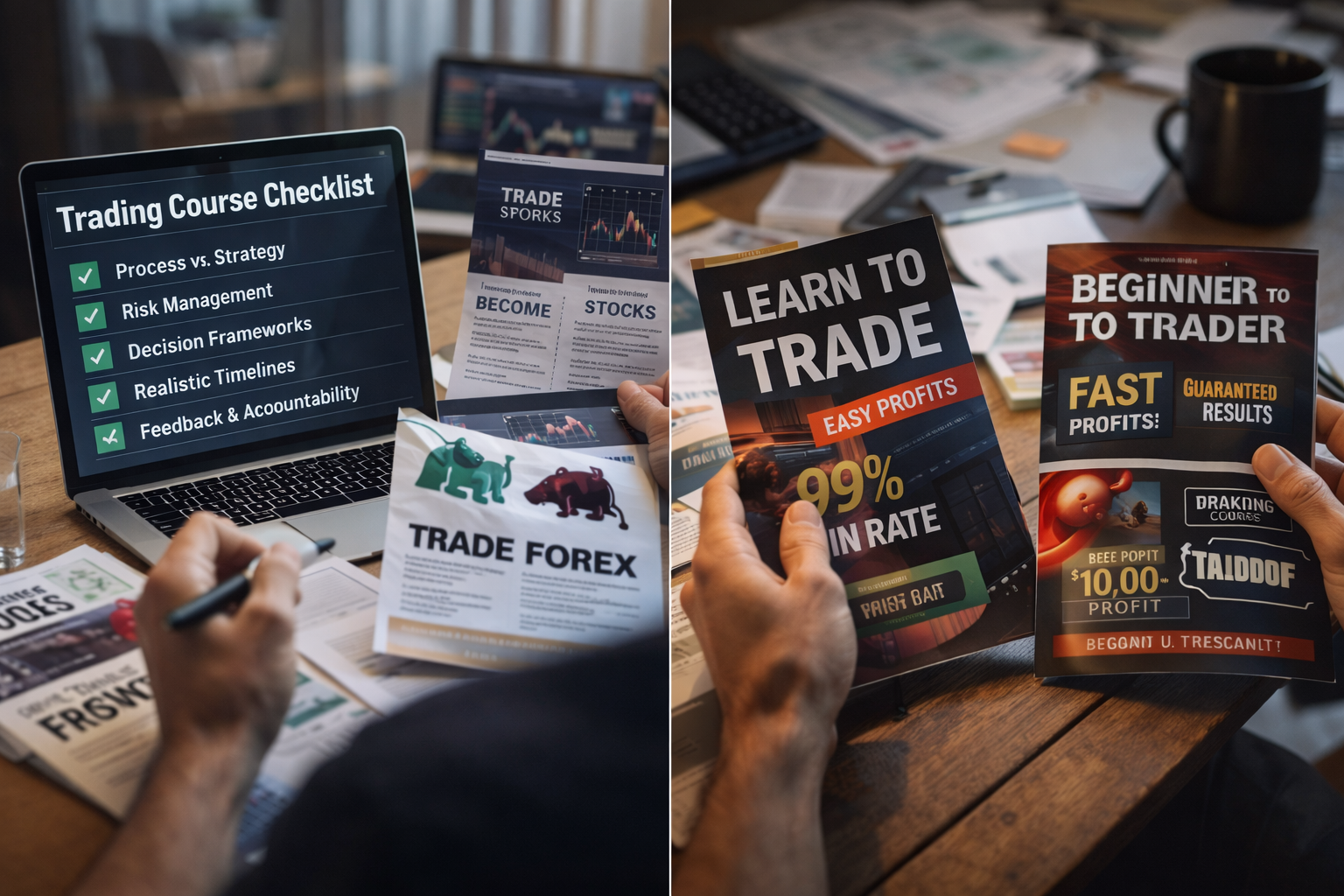
A Simple Checklist to Judge If a Trading Course Is Worth Paying For
Use this checklist before committing any money:
- Leads with process, not strategies: explains how decisions are made before showing trades
- Risk management is foundational: position sizing, drawdown control, and capital protection are central
- Decision frameworks are explicit: clear rules for when to trade, stand aside, and adapt
- Realistic timelines: acknowledges uneven progress and avoids quick-results promises
- Review and feedback loops: guidance on journaling, review, or mentoring for accountability
If a course fails several of these tests, it is unlikely to deliver long-term value.
Why Most Traders Choose Courses for the Wrong Reasons
Many traders select courses based on price, promises, or simplicity. These signals feel reassuring but rarely correlate with durable outcomes.
Courses chosen for excitement or speed often collapse under real market conditions because they do not teach how decisions are made under uncertainty. Serious traders should evaluate education on structure and durability, not surface appeal.
What the Course Leads With Reveals Its Quality
High-quality trading education leads with process and risk. Low-quality courses lead with setups, indicators, or profit examples.
If a course promises profits, win rates, or shortcuts early, it is unlikely to build transferable skill. Professional education explains why decisions are taken before showing what trades look like.
Risk Management Depth Is Non-Negotiable
A course worth paying for treats risk management as the core skill. It explains exposure, position sizing, drawdown limits, and capital preservation in detail.
Courses that merely mention stop losses without broader context are incomplete. Without professional risk education, even strong analysis fails over time.
Does the Course Teach Decision Frameworks
Professional traders operate within decision frameworks that guide action under uncertainty. These frameworks define when to trade, when to wait, and how to respond as conditions change.
Courses worth paying for explain decision logic, not just entries. Frameworks protect traders when markets behave unexpectedly.
Process Over Outcomes
Valuable courses emphasise process adherence rather than short-term results. Traders learn to judge success by decision quality, not individual wins or losses.
Outcome-focused education reinforces emotional trading. Process-led education builds consistency by anchoring behaviour to standards.
Realistic Timelines Signal Credibility
Courses worth paying for set honest expectations. They recognise that consistency takes time and that progress is uneven.
Unrealistic timelines are a red flag. Education that promises rapid transformation often fails under live conditions, leading to frustration and burnout.
Review, Feedback, and Accountability Matter
Structured review is essential for improvement. Courses that include feedback guidance, journaling structure, or mentoring accelerate development.
Passive consumption limits growth. Traders need mechanisms to identify errors, reinforce discipline, and refine behaviour over time.
Transparency About Limits Builds Trust
High-quality courses are transparent about what they do not cover and what the trader must develop independently.
Overconfident courses that claim completeness often hide gaps. Professional education respects complexity and uncertainty.
Who the Course Is Actually Designed For
Courses worth paying for define their audience clearly. They are not designed for everyone.
If a course claims to suit “anyone” or “complete beginners to professionals,” depth is usually lacking. Precise audience definition signals seriousness.
How to Make the Final Decision
Before paying, ask whether the course would still be valuable if market conditions changed completely.
If the education is process-led, risk-aware, and framework-driven, it will remain relevant. If not, it will expire quickly. Choosing correctly once is cheaper than restarting repeatedly.
Frequently Asked Questions
How do I know if a trading course is worth paying for
A trading course is worth paying for if it teaches structured process, professional risk management, decision frameworks, and realistic timelines. Courses that focus on shortcuts, profits, or win rates usually fail to build durable skill.
Are expensive trading courses always better
Expensive courses are not automatically better. However, professional-level education often costs more because it requires depth, structure, and feedback rather than surface-level content or marketing claims.
Should a trading course guarantee results
No credible trading course should guarantee results. Guarantees usually signal marketing rather than education, as trading outcomes depend on execution, discipline, and changing market conditions.
Is mentoring a sign of course quality
Mentoring can indicate higher quality when it reinforces process, accountability, and structured feedback. Mentoring without a clear framework or standards is not sufficient on its own.
What is the biggest red flag in trading courses
The biggest red flag is a focus on profits, win rates, or speed instead of process, risk discipline, and decision-making standards that support long-term consistency.