
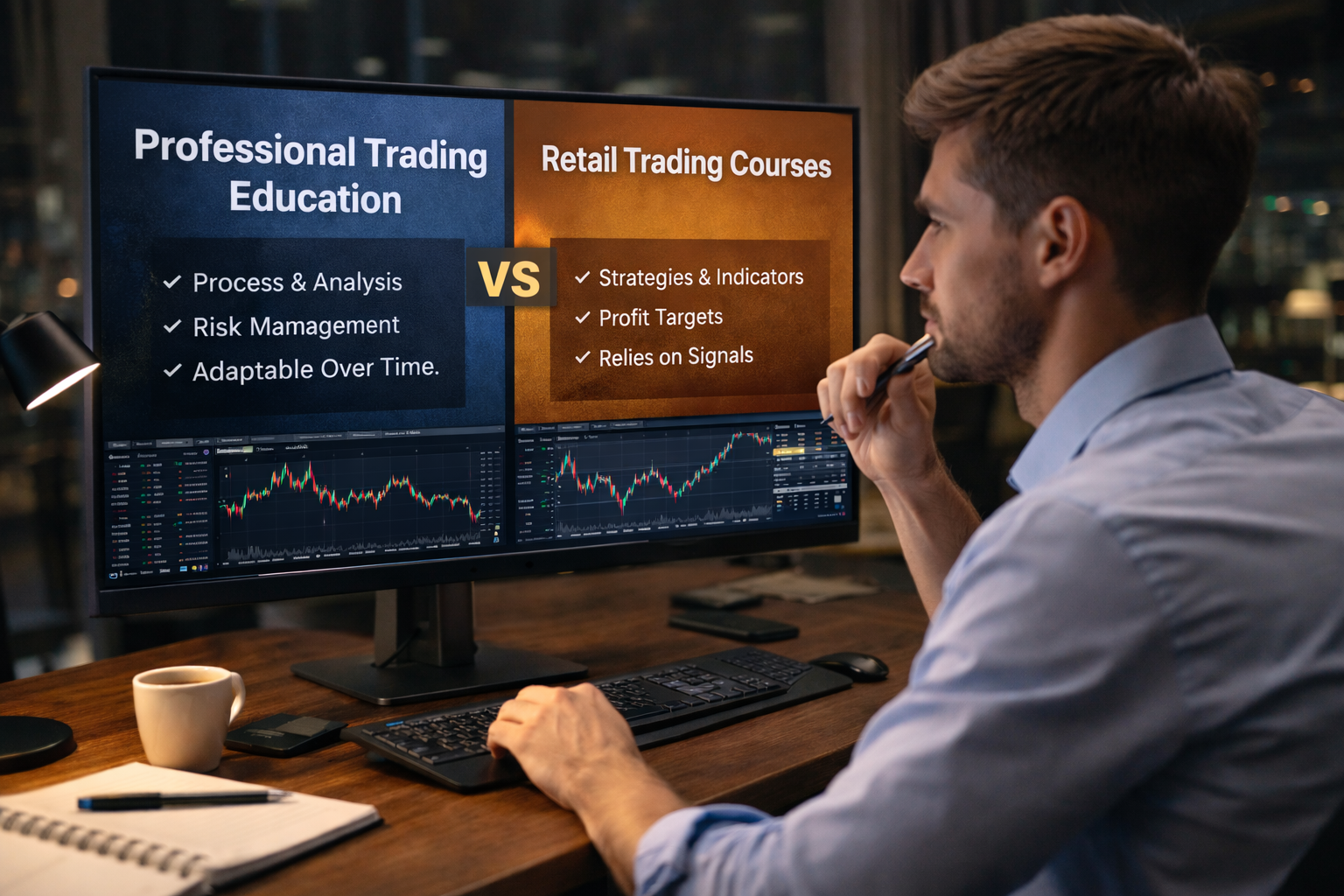
Professional Trading Education vs Retail Trading Courses Explained
Professional trading education vs retail trading courses is a comparison searched by people who want to choose the right learning path and avoid costly mistakes. This article explains the real differences between institutional-style professional trading education and retail trading courses, how each develops traders, and which approach supports long-term consistency. It is written for serious learners evaluating trading education quality, outcomes, and career relevance rather than price or promises.
Professional trading education builds process, risk discipline, and decision-making frameworks, while retail trading courses typically focus on strategies, indicators, and short-term tactics.
What Professional Trading Education Really Means
Professional trading education is designed to build transferable skills that remain effective across market cycles. It teaches how to analyse markets, manage risk, and make consistent decisions under uncertainty.
Rather than focusing on isolated setups, professional education integrates macroeconomics, market structure, technical frameworks, execution rules, and trading psychology into one coherent process. This mirrors how traders are developed in institutional environments and supports long-term consistency.
What Retail Trading Courses Typically Focus On
Retail trading courses usually focus on tactics such as indicators, chart patterns, entry signals, or simplified rule sets. These courses are often designed to feel accessible and quick to apply.
However, this approach often lacks context. Learners are taught what to trade without understanding why markets move, how conditions change, or how risk should be controlled over time. As a result, many traders struggle when volatility, liquidity, or macro conditions shift.
Professional vs Retail Trading Education: Quick Comparison
Professional trading education emphasises process over strategy. Retail courses emphasise strategies over process.
Professional education is risk-first, prioritising capital preservation and drawdown control. Retail education often appears profit-first, focusing on win rates or targets.
Professional frameworks adapt across market environments, while retail rules often fail outside narrow conditions.
Professional education develops independent thinking. Retail courses frequently create reliance on tools, indicators, or signals.
How Institutions Train Traders
Institutional trading environments focus on education, supervision, and continuous review. Trainees study macroeconomic drivers, policy decisions, market structure, and risk frameworks before taking responsibility.
Central banks and policy institutions influence markets through interest rates, liquidity provision, and regulation. Professional trading education teaches how to interpret these forces systematically rather than react emotionally to price movement. This structured development explains why institutional trading education differs fundamentally from retail courses.
Who Benefits From Professional Trading Education
Professional trading education suits individuals who value structure, consistency, and credibility. This includes career switchers, aspiring professional traders, and serious learners who want robust decision-making frameworks.
It also suits traders who have tried retail trading education and found it inconsistent or fragile. For these learners, depth and adaptability matter more than speed.
Who Retail Trading Courses Are Designed For
Retail trading courses are often designed for beginners seeking quick exposure to markets. They may suit individuals exploring trading casually or learning basic terminology.
However, as expectations rise, limitations appear. Retail education rarely provides the depth needed for professional-level risk control, adaptability, and long-term consistency.
Understanding this distinction prevents misaligned education choices.
Common Mistakes When Choosing Trading Education
A common mistake is choosing education based on simplicity rather than robustness. Simple systems often break down in complex markets.
Another mistake is assuming all trading education is equal. Quality varies significantly, and outcomes reflect this difference. Professional traders prioritise education that builds thinking skills, not dependency.
Can Retail Trading Courses Lead to Professional Trading
Retail trading courses can introduce basic concepts, but most professional traders eventually require deeper education. Transitioning from retail learning to professional frameworks often involves unlearning habits and rebuilding process discipline.
Starting with professional trading education reduces this friction and supports more consistent development.
Choosing the Right Trading Education Path
The right trading education path depends on long-term goals. Those seeking casual exposure may choose retail trading courses. Those seeking a professional trading career benefit from structured, institutional-style education.
Evaluating education through the lens of process, risk management, adaptability, and review leads to better decisions and more sustainable outcomes.
Frequently Asked Questions
What is the difference between professional trading education and retail courses
Professional trading education focuses on process, risk management, and decision-making frameworks that adapt across market conditions. Retail trading courses often focus on strategies, indicators, or simplified rules that can fail when conditions change, limiting long-term consistency.
Are retail trading courses a waste of time
Retail trading courses are not always a waste of time, as they can introduce basic concepts and terminology. However, many traders outgrow them quickly and seek professional trading education to develop deeper analytical skill, risk discipline, and long-term consistency.
Can beginners start with professional trading education
Beginners can start with professional trading education when it is structured and clearly explained. This approach often prevents bad habits, reduces reliance on indicators or signals, and builds correct decision-making frameworks from the beginning.
Why do professional traders avoid signal-based courses
Professional traders avoid signal-based courses because they do not build independent thinking or adaptability. Signals limit understanding of market context and risk, which prevents traders from developing sustainable professional-level decision-making skills.
Which type of trading education is better for a career
Professional trading education is better for a career because it develops transferable analytical skills, risk control, and adaptability. These qualities allow traders to remain consistent across different market environments and economic cycles.