
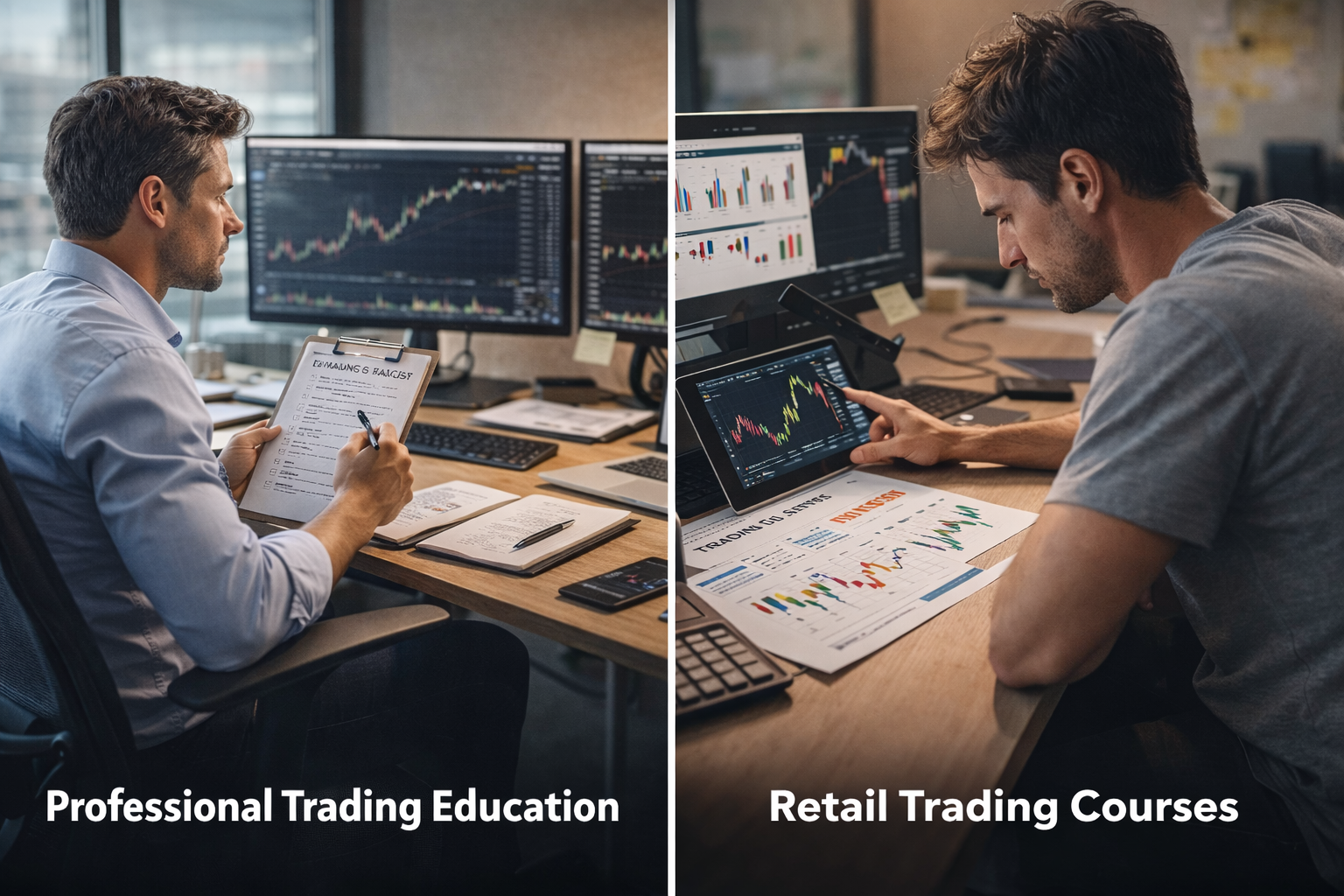
How Professional Trading Education Differs From Retail Trading Courses
Most traders assume all trading education is broadly the same, differing only in price or presentation. In reality, professional trading education differs fundamentally from retail trading courses in structure, objectives, and standards. This article explains how professional trading education differs from retail trading courses, why those differences matter, and how they shape long-term trading development for serious traders considering an upgrade.
Professional trading education builds decision-making skill, risk discipline, and process standards, while retail trading courses focus on tools, tactics, and short-term outcomes.
Professional Trading Education vs Retail Trading Courses: At a Glance
The distinction is structural, not cosmetic:
- Process-led vs tactic-led: professionals learn decision frameworks; retail courses teach setups
- Risk embedded vs risk mentioned: professionals enforce risk control; retail courses reference it
- Standards vs outcomes: professionals measure behaviour; retail courses measure profits
- Skill development vs information delivery: professionals train judgement; retail courses deliver content
- Long-term consistency vs quick results: professionals prepare careers; retail courses sell speed
These differences determine whether education produces durable skill or temporary confidence.
What Retail Trading Courses Typically Emphasise
Retail trading courses usually prioritise indicators, patterns, and entry techniques. They promise clarity, simplicity, or fast progress.
While this material can be useful, it is rarely placed inside a broader decision framework. Traders learn what to trade without learning how to think, adapt, or manage uncertainty when conditions change.
What Professional Trading Education Prioritises
Professional trading education starts with process. Traders learn how to analyse markets, assess context, control risk, and review decisions systematically.
Strategies are secondary. The primary objective is consistent decision-making under uncertainty, not short-term profitability.
Risk Management Is Treated Very Differently
In retail courses, risk management is often reduced to stop losses and fixed percentages.
In professional education, risk management governs every decision. Exposure, position sizing, drawdown limits, and behavioural risk are embedded into the trading process and enforced consistently as professional standards.
Decision Frameworks Replace Signals
Retail education often relies on signals that tell traders when to act.
Professional education replaces signals with frameworks. Traders learn how to evaluate conditions, decide whether to trade, and determine appropriate risk dynamically. This develops independence rather than dependence.
Review and Accountability Are Core Components
Retail courses are commonly consumed passively. Once content ends, development stalls.
Professional education includes structured review. Decisions are evaluated against standards, mistakes are identified objectively, and behaviour is refined through feedback over time.
Time Horizons Are Set Realistically
Retail trading courses often imply rapid progress or quick results.
Professional education sets realistic timelines. Skill development is framed as gradual, uneven, and cumulative. This honesty protects traders from burnout and unrealistic expectations.
How Professional Education Shapes Trader Identity
Professional education reshapes how traders define success. Success becomes adherence to process, risk discipline, and decision quality rather than isolated wins.
This identity shift is critical. Traders stop chasing outcomes and start building consistency.
Why Retail Courses Feel Easier at First
Retail courses feel easier because they reduce complexity and promise certainty.
Professional education feels harder because it removes shortcuts and forces traders to confront uncertainty. That difficulty is what builds resilience and adaptability.
Choosing Between Retail and Professional Education
The correct choice depends on goals. Traders seeking entertainment, signals, or quick wins may prefer retail courses.
Traders seeking consistency, longevity, and professional standards require education built around process, discipline, and structured review.
Frequently Asked Questions
What is the main difference between professional and retail trading education
The main difference is focus. Professional trading education builds decision-making skill, risk discipline, and structured process, while retail trading courses concentrate on tools, tactics, and short-term outcomes without consistent behavioural standards.
Are retail trading courses useless
Retail trading courses are not useless, but they are limited. Without embedded process, professional risk standards, and structured review, they rarely produce traders who achieve long-term consistency.
Does professional trading education take longer
Professional trading education often takes longer initially. However, it reduces total learning time by preventing repeated failure cycles, rebuild phases, and emotional burnout common in retail learning paths.
Can retail traders transition to professional-style education
Yes. Many traders begin with retail education and later transition by adopting structured process, disciplined risk management, and feedback-driven learning frameworks.
Is professional trading education worth the higher cost
Professional trading education typically costs more because it includes structure, depth, and standards. For traders seeking long-term consistency, it is often more cost-effective over time.