
How to Choose the Best Trading Course for Serious Traders
How to choose the best trading course is a critical question for serious traders who want long-term consistency rather than short-term tactics. This article explains how to evaluate trading courses using professional standards, what separates institutional-style education from generic online offerings, and how to select a course that genuinely supports career-level development. It is written for readers with clear intent, realistic expectations, and a focus on durable skill building.
The best trading course is defined by structure, risk discipline, and decision-making frameworks, not marketing claims or strategy promises.
What Makes a Trading Course “The Best”
The best trading course builds durable skills that survive changing market conditions. It teaches how to analyse markets, manage risk, and make decisions under uncertainty. Moreover, it prioritises process over prediction and consistency over outcomes.
Courses that promise speed or certainty rarely support long-term development. In contrast, professional education sets realistic timelines and emphasises behavioural discipline.
Professional Trading Courses vs Generic Online Courses
Professional trading courses replicate institutional thinking. They integrate macro context, market structure, technical frameworks, execution discipline, and psychology into one workflow. As a result, learners develop adaptable decision-making rather than fixed rules.
Generic online courses often focus on isolated strategies or indicators. While simple at first, these approaches typically lack robustness and fail as conditions change.
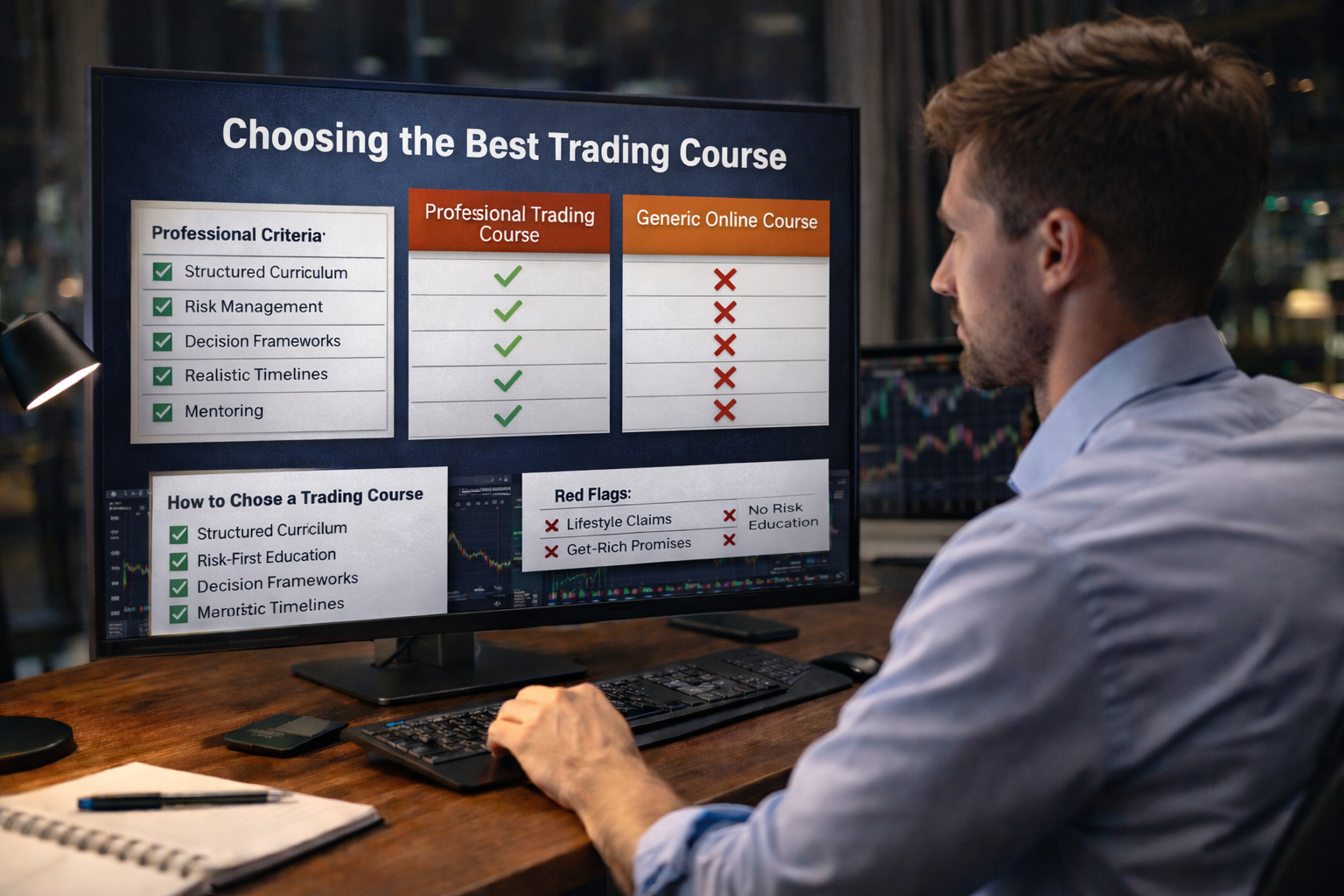
How to Choose the Best Trading Course: A Professional Checklist
Use this checklist to compare courses objectively:
- Structured curriculum: concepts progress logically from foundations to application.
- Risk-first education: capital preservation and drawdown control are central.
- Decision-making frameworks: the course teaches how to think, not what to copy.
- Adaptability: methods work across volatility regimes and market cycles.
- Realistic timelines: development is measured in years, not weeks.
- Review and feedback: learning includes reflection and correction, not just content.
Courses that meet these criteria are far more likely to support professional outcomes.
Key Criteria for Evaluating a Trading Course
Structured Curriculum
A professional trading course follows a clear progression. Foundational concepts support advanced application, which improves retention and practical use. Disorganised content often signals weak educational design.
Risk Management First
Risk management must be central, not optional. Courses that focus on entries before risk usually prioritise excitement over survivability. Professional traders measure success by downside control.
Decision-Making Frameworks
The best courses teach frameworks for evaluating markets. Consequently, learners gain independence and adaptability instead of reliance on scripts or signals.
Realistic Expectations
Quality courses set honest expectations. They acknowledge that professional trading development takes time and disciplined practice, which filters out unsuitable candidates and improves outcomes.
Signs of Low-Quality Trading Courses
Low-quality courses often rely on lifestyle marketing, income claims, or secret strategies. They rarely explain why methods work or when they fail.
Another warning sign is the absence of risk education. If drawdowns and capital preservation are ignored, the course is incomplete and potentially harmful.
Who Should Invest in Professional Trading Education
Professional trading education suits individuals who value structure, consistency, and credibility. This includes career switchers, analytical professionals, and traders who have struggled with retail-level material.
It also suits learners seeking accountability and a clear development pathway. For these individuals, depth matters more than speed.
Mentoring vs Self-Paced Trading Courses
Self-paced courses provide flexibility and structure, which suits disciplined learners. Mentoring adds feedback, accountability, and early correction, which accelerates progress.
Many serious traders combine both approaches to optimise development.
Cost vs Value in Trading Education
Cost should be evaluated against value. Cheap education that leads to repeated losses is expensive over time. Conversely, professional education may require higher upfront investment but reduces costly trial-and-error cycles.
Value is measured by skill development and decision quality, not price.
How to Align a Trading Course With Career Goals
Choosing the right trading course requires clarity about goals. Casual learners and aspiring professionals need different levels of depth. Professional goals require professional standards.
Selecting education aligned with those standards improves long-term consistency and confidence.
Making an Informed Decision
The best trading course aligns with your objectives, teaches structured decision-making, and prioritises risk discipline. Evaluating courses through this lens leads to better outcomes than relying on reviews or promises alone.
Frequently Asked Questions
How do I choose the best trading course
Choose a trading course by assessing its curriculum structure, risk management focus, decision-making frameworks, and realism. Courses that emphasise process and discipline support long-term development better than strategy-based offerings.
Are expensive trading courses worth it
Expensive trading courses can be worth it when they deliver structured professional education, robust frameworks, and risk discipline. Value depends on educational depth and relevance to long-term goals, not price alone.
What should a professional trading course include
A professional trading course should include market analysis frameworks, risk management, execution discipline, psychology, and continuous review. Together, these elements support consistent decision-making across market conditions.
Is mentoring necessary in trading education
Mentoring is not always necessary, but it often accelerates development. Feedback and accountability help traders correct errors early and refine decision-making processes.
Can beginners choose professional trading courses
Beginners can choose professional trading courses if the material is clearly structured and sets realistic expectations. Starting with correct frameworks often prevents bad habits later.