
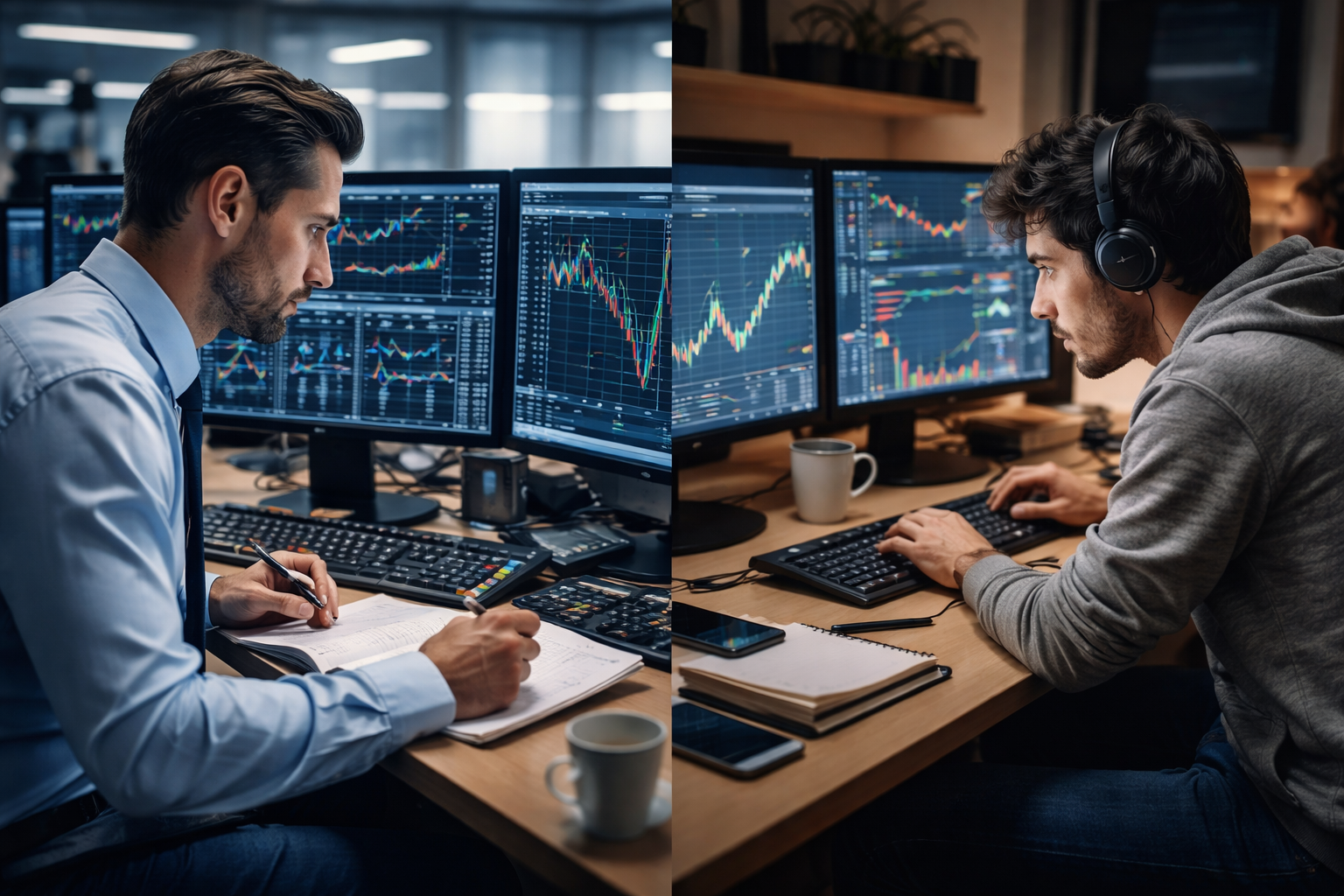
What Separates Professional Traders From Retail Traders
What separates professional traders from retail traders is one of the most important questions for anyone serious about trading as a long-term profession. This article explains the real differences between professional and retail traders, how professionals think and operate, and why most retail traders struggle to achieve consistency. It is written for individuals evaluating whether they are ready to adopt professional trading standards rather than retail habits.
Professional traders are separated from retail traders by process, risk discipline, and decision-making consistency-not by strategies, tools, or market access.
What a Professional Trader Actually Is
A professional trader is defined by behaviour and standards, not by job title or account size. Professional traders operate with structured processes, controlled risk, and repeatable decision-making across market conditions.
They measure success by decision quality and capital preservation first. Over time, profitability becomes a consequence of discipline rather than the objective itself.
Retail traders, by contrast, often focus on short-term outcomes before building a stable process.
Professional Traders vs Retail Traders: Key Differences
The core differences are structural rather than technical:
- Decision-making: professionals follow predefined frameworks; retail traders react emotionally
- Risk exposure: professionals control downside first; retail traders prioritise upside
- Time horizon: professionals think in years; retail traders think in trades
- Education: professionals invest in structured learning; retail traders rely on tips or tactics
- Performance review: professionals review process; retail traders review results
These differences explain why performance diverges over time.
How Professional Traders Think Differently
Professional traders think in probabilities rather than predictions. They accept uncertainty and focus on whether a decision fits their framework and risk limits.
Because of this, emotions play a smaller role in execution. Losses are treated as part of the process, not as personal failure.
Retail traders often seek certainty, confirmation, or reassurance, which increases emotional pressure and inconsistency.
Process vs Strategy: The Core Divide
Professional traders operate within clearly defined processes that govern analysis, execution, risk management, and review.
Strategies are tools inside that process, not the foundation. When market conditions change, professionals adapt because their process remains intact.
Retail traders often build their entire approach around a single strategy. When it stops working, confidence and consistency disappear.
Risk Management Is the Real Separator
Risk management defines professional trading standards. Professionals control position size, limit drawdowns, and prioritise survival over opportunity.
They understand that avoiding large losses matters more than maximising gains. This discipline compounds over time.
Retail traders often focus on entries, targets, or win rates while underestimating total risk exposure.
Professional Trading Education vs Retail Learning
Professional traders invest in structured education that explains how markets function and how decisions are made under uncertainty.
This education integrates macro context, market structure, technical frameworks, execution discipline, and psychology into one coherent workflow.
Retail learning usually focuses on isolated tactics without context, which produces fragile performance.
Review, Accountability, and Feedback
Professional traders review decisions objectively. They ask whether trades followed process rather than whether they won or lost.
This feedback loop drives continuous improvement. Accountability-either personal or mentored-reinforces discipline.
Retail traders often review outcomes emotionally, which limits learning and encourages repetition of mistakes.
Time Horizon and Expectations
Professional traders operate with long development horizons. They expect skill acquisition to take years and plan accordingly.
Retail traders often expect rapid progress. When results disappoint, behaviour becomes reactive and inconsistent.
Expectation management is a critical professional standard.
Tools Do Not Create Professionals
Professional traders do not rely on secret indicators or exclusive tools. They rely on reasoning, discipline, and structured decision-making.
Retail traders often search for better tools instead of better processes, which delays progress.
Can Retail Traders Become Professional Traders
Retail traders can become professional traders by changing standards. This requires adopting structured education, disciplined risk management, and realistic timelines.
The transition is behavioural rather than technical. Those willing to make this shift significantly improve long-term consistency.
Choosing the Professional Path
Professional trading is a deliberate choice. It requires patience, discipline, and commitment to continuous improvement.
Those who adopt professional standards separate themselves from the majority of retail traders over time.
Frequently Asked Questions
What is the main difference between professional and retail traders
The main difference is process. Professional traders follow structured decision-making frameworks and disciplined risk management, while retail traders often rely on strategies, tools, or emotion-driven decisions.
Do professional traders use different strategies than retail traders
Professional traders may use similar tools or indicators, but they apply them within broader decision-making frameworks. The process, not the strategy, creates consistency across market conditions.
Is risk management more important than strategy
Risk management is more important than strategy because it determines survivability and long-term consistency. Without controlled risk, even good strategies eventually fail.
Can retail traders become professional traders
Retail traders can become professional traders by adopting structured education, disciplined risk management, and realistic expectations about development timelines and performance variability.
Do professional traders trade full-time
Some professional traders trade full-time, while others do not. Professionalism is defined by process, discipline, and decision quality rather than hours worked.