
Financial Markets Explained: The Global System and Six Asset Classes
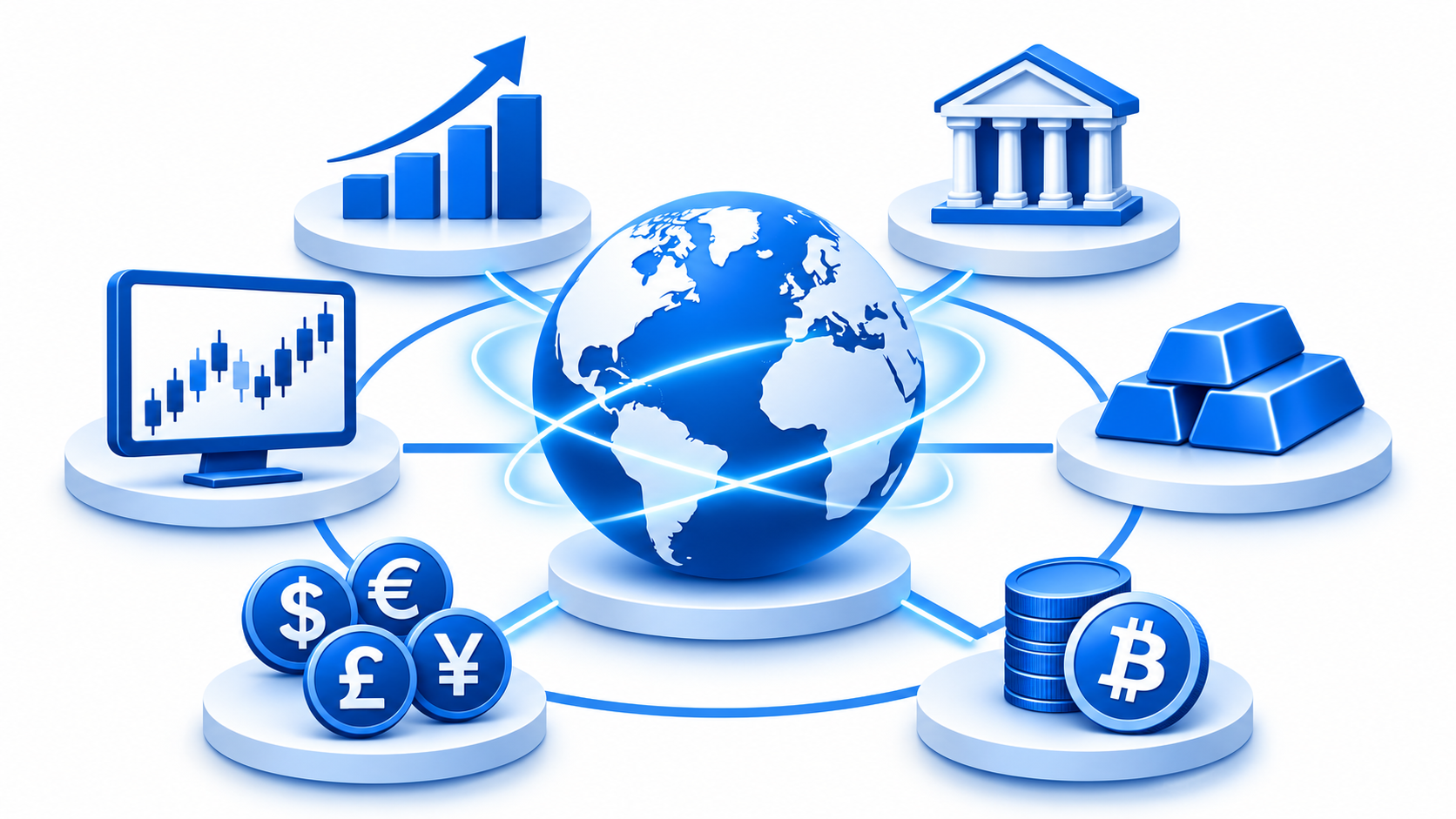
Financial markets connect people and institutions that need capital with those willing to supply it, while helping participants exchange assets and manage risk. Stocks, bonds, currencies, commodities, cryptocurrency and index-linked instruments operate under different legal and economic mechanisms. Understanding their similarities and differences is the foundation for credible multi-asset market analysis.
This guide explains what financial markets do, how prices form, the institutions that operate them, how markets are linked and why market value can change even when an asset’s underlying contract has not. It distinguishes financial education from predictions: a market narrative is useful only when its assumptions and limitations are clear.
What are financial markets and why do they exist?
Financial markets are systems where buyers and sellers exchange financial claims or assets at prices formed through trading and valuation. Their central economic function is to connect people and institutions that have funds with those seeking finance, while allowing investors to transfer risk and adjust portfolios. Markets provide prices, but they cannot guarantee that those prices are fair or that participants will earn a positive return.
Companies may raise new equity for investment; governments borrow through debt securities; businesses hedge future currency or commodity prices; investors exchange existing securities. Trading after issuance is essential because participants often need to sell before a bond matures or a company’s shares change hands. Market access and liquidity help make financing possible, but both can deteriorate under stress.
The difference between the financial system and financial markets
The financial system is broader than tradeable markets. It includes commercial banks, payment networks, insurance, pensions, central banks, regulation, deposit services and the legal infrastructure governing financial contracts. Financial markets are the part of that system where specified assets, claims and risks are priced and exchanged. A bank loan may be financial intermediation even if it never trades on an exchange.
The distinction matters during crises. A stock exchange may continue publishing prices while banks or clearing systems experience funding disruption; conversely, stable payment systems can support market functioning even when investment prices fall. Operational resilience and asset valuation are different questions.
Six major asset classes in a multi-asset trading education
For a practical multi-asset research framework, traders commonly examine foreign exchange, stocks, bonds and fixed income, commodities, cryptocurrency, and stock indices. Stock indices are benchmarks rather than a separate underlying economic claim, but index-linked products are widely used to express equity-market exposure, so they are useful as a distinct educational category.
Some broader institutional asset-allocation frameworks classify private equity, real estate, alternatives or derivatives differently. The number of asset classes is therefore a framework choice, not an immutable financial law. Derivatives are contractual instruments whose underlying exposures can belong to several classes.
Stocks: ownership claims and earnings expectations
A share represents an ownership interest under the issuing company’s legal structure, generally exposing investors to residual profits, capital allocation decisions and valuation changes. Companies can issue shares to raise capital, while secondary-market transactions usually exchange existing ownership between investors. A share price responds to expected future cash flows, financing conditions, investor sentiment and available liquidity.
For example, a company can report higher annual profit but experience a lower share price if investors had expected even greater growth or if the discount rate used to value future earnings rises. A good business is not automatically a good investment at every price. Explore Stocks and Shares Explained for the equity-specific fundamentals.
Bonds and fixed income: contractual cash flows
A conventional bond is debt issued by a government or business that promises defined coupon and principal payments, subject to its terms and the issuer’s ability to pay. Bondholders differ from ordinary shareholders because they are creditors rather than residual owners. Yet fixed contractual payments do not imply stable market prices.
If required yields increase, the present value of an ordinary fixed-rate bond’s future cash flows generally falls. Longer-duration bonds tend to be more sensitive to such moves. Credit spreads, inflation and liquidity also affect traded prices. See What Are Bonds? for the contractual structure and risks.
Foreign exchange: the relative price of currencies
The foreign exchange market facilitates the exchange of one currency for another. A currency pair such as GBP/USD expresses the dollar price of one pound, with the actual quote and settlement arrangements depending on the instrument. International trade, cross-border investment, hedging and financial transactions create demand for currency conversion.
Central-bank policy, interest-rate differentials, trade expectations, capital flows and positioning influence prices, but no single factor determines all moves. The BIS’s 2025 Triennial Survey provides detailed evidence about over-the-counter foreign-exchange turnover and instruments. See What Is Forex Trading? for market mechanics.
Commodities: physical markets and financial contracts
Commodities include energy products, metals and agricultural goods. Prices can depend on physical supply, inventories, transportation, seasonal demand, geopolitics and financial conditions. Spot commodities, forward contracts, exchange-traded futures and commodity-linked investment products offer different exposures and delivery terms.
For example, a rise in crude oil prices could reflect an actual production disruption, increased expected demand, transport constraints or a change in risk premium. The price of a futures contract additionally reflects expiry, storage, financing and delivery conditions. A financial instrument referencing oil does not necessarily represent ownership of physical barrels.
Cryptocurrency: programmable assets and distinct risks
Cryptoassets use distributed ledgers or related cryptographic arrangements to record transfers and enforce rules. Bitcoin and Ether have distinct consensus, issuance and economic structures. A token on a blockchain may or may not confer a financial claim, voting rights or redemption entitlement. Public transaction records alone do not establish the holder’s legal protections.
Crypto markets can be fragmented, highly speculative and vulnerable to custody failures or severe losses. The FCA’s rules distinguish qualifying cryptoasset promotions from particular derivatives and other product types. See Cryptocurrency Explained for the underlying technology and risks.
Stock indices: benchmarks rather than shares
A stock index measures a selected basket of equities under published eligibility and weighting rules. The S&P 500, Nasdaq-100 and FTSE 100 each follow different methods, so the headline numbers do not describe identical markets. An index level is a calculation; investors obtain exposure through specific products such as funds or futures.
Sector concentration, constituent weighting, dividend treatment and currency conversion all matter. A benchmark can rise while most listed companies fall if its largest constituents outperform. See Stock Market Indices Explained.
Primary markets versus secondary markets
The primary market is where new securities are issued and new financing reaches the issuer, under the offering terms. The secondary market is where investors subsequently exchange existing securities. A company receives proceeds from an IPO, but it does not ordinarily receive cash each time an existing share changes hands on the stock exchange.
Secondary liquidity helps investors become willing to finance future issuance because they can potentially sell their holdings. Nevertheless, secondary prices can decline sharply and may become difficult to execute at during disruption. Read Primary and Secondary Markets Explained.
Money markets versus capital markets
Money markets generally involve short-term financing and liquidity instruments, such as Treasury bills or certain wholesale funding arrangements. Capital markets generally involve longer-term debt and equity financing. The boundary is an analytical convention rather than an assertion that every instrument fits neatly into one category.
Short-term funding matters because banks, brokers and businesses must meet immediate cash obligations. A solvent institution holding valuable long-term assets can encounter serious difficulty if short-term financing disappears. Funding-market conditions therefore influence trading capacity in other asset markets.
Who participates in the global financial system?
Participants include households, corporations, sovereign issuers, commercial banks, central banks, institutional funds, brokers, dealers, exchanges, insurers, clearing houses and custodians. Each has a different objective: a pension fund may seek to match long-term liabilities, while a business may hedge currency payments and a dealer may manage quoted inventory risk.
These motives can push markets in different directions even when everyone sees the same public data. See Financial Market Participants Explained for how the institutions connect.
How markets create prices
Prices form when bids, offers and completed transactions interact with valuations and expectations. The relevant price reflects the marginal buyer and seller, not an objective average opinion of everyone in the economy. New information changes estimates of future cash flows, risks or financing costs, while liquidity influences how far prices must move to find willing counterparties.
Suppose an imaginary company’s expected annual earnings rise 5%, but investors reduce its valuation multiple by 10% in response to higher discount rates. The resulting equity value can fall despite improving earnings. A financial asset is worth what can be exchanged at the applicable time, not what its original buyer hoped to receive.
Price discovery, market data and executed trades
A last-traded price, midpoint quote and executable price are not necessarily the same. Markets can display narrow spreads for small quantities but require progressively worse prices for large orders. The timestamp, venue, trade size and underlying security identifier must be recorded when comparing data.
Dealers may publish indicative valuations that are not firm offers. A market can have high reported volume yet poor current depth. For price formation and liquidity measurement read How Market Prices Are Formed.
What makes markets interconnected?
The same economic shock can change corporate profits, expected central-bank rates, currency flows and commodity demand at once. A rise in energy prices may increase revenues for some producers, raise inflation pressures for households and affect government bond yields. The effects depend on starting valuations, policy expectations and the source of the shock.
Interconnection does not mean permanent correlations. Government bonds can rally with declining stocks during some growth scares, but stocks and nominal bonds may fall together during inflation shocks. Cross-asset analysis therefore uses conditional scenarios rather than fixed slogans.
Global financial-market hours and access
Different markets follow different calendars and trading conventions. Many currency markets trade continuously through the international business week, while major equity exchanges hold scheduled cash sessions. Futures can trade beyond cash-market hours, and many crypto spot venues operate around the clock.
An overnight futures move may not represent an immediately executable trade in every underlying share, and a quoted commodity price may refer to a different delivery month. Market hours, venue access and settlement time all affect comparability and execution.
How central banks influence financial conditions
Central banks set or influence short-term monetary conditions through policy rates and other tools. The Bank of England describes policy transmission as affecting financial asset prices, market interest rates and exchange rates before influencing spending, activity and inflation over time. Expectations of policy changes can affect valuations even before a formal rate decision.
A widely expected policy cut may move prices less than an unexpected change in the projected path of rates. Markets care about surprises relative to what was already embedded in asset prices. See Bank of England research on monetary transmission.
The role of clearing, settlement and collateral
Executing a trade is not the same as completing the exchange of securities and cash. Trading venues and brokers arrange execution, while clearing, custodial and payment systems support obligations and final settlement. Some contracts require initial and variation margin to manage counterparty risk.
Settlement calendars vary by market and jurisdiction. A US share transaction typically settles on T+1 under current rules, while UK markets were operating on T+2 in 2026 with a planned move to T+1 in 2027. The instrument and venue must be checked rather than assuming one global settlement rule.
Financial market risk categories
Market risk concerns price changes; credit risk concerns a borrower or counterparty failing to perform; liquidity risk concerns the cost or impossibility of trading when needed. Operational risk involves systems, people and processes. Legal and regulatory risks concern enforceable rights, restrictions and changing rules. Currency risk changes the home-currency value of foreign holdings.
These risks can reinforce one another. Falling prices can increase margin calls, forcing sales into thin markets, while funding stress makes dealers less willing to hold inventory. A large trading account balance does not eliminate the need to understand the actual security, leverage and custody arrangement.
A practical multi-asset research sequence
Start by identifying the economic exposure rather than an attractive-sounding product name. Record the exact security or contract, issuer or counterparty, currency, maturity or expiry, trading venue and benchmark. Next, examine relevant economic conditions, cash flows and market expectations. Then evaluate price, liquidity and plausible downside scenarios.
For a cross-asset view, write how the same proposed catalyst might affect stocks, bonds, FX and commodities differently. Ask what would falsify the hypothesis. Structured research can improve decisions but cannot guarantee favourable results. The Atravix Six-Pillar Framework provides the full process.
Major financial markets at a glance
| Market category | Underlying exposure | Key driver or risk |
|---|---|---|
| Stocks and equities | Ownership in companies | Profit expectations and valuation |
| Fixed income | Debt and interest payments | Rates, duration and default |
| Foreign exchange | Relative currency value | Policy expectations and cross-border flows |
| Commodities | Physical goods or linked contracts | Inventories, supply and demand |
| Cryptocurrency | Protocol assets or issued tokens | Token rights, adoption and custody |
| Stock indices | Calculated basket benchmarks | Constituent weighting and sector concentration |
Educational grouping used in Traders MBA; instruments and exposures can overlap.
How financial market capital becomes a real-world investment
Financial-market financing is linked to the real economy through the choices issuers make with raised capital. A business may sell new shares to build a factory or invest in technology, while a government sells debt to finance eligible public expenditure and refinance existing obligations. The subsequent outcomes depend on whether those funds are deployed productively and whether the issuer can meet future claims.
For example, a fictional company raising £50 million through new shares could spend the funds on expansion. Shareholders now own residual claims on the enlarged business, but the project may disappoint or exceed expectations. The amount raised does not itself imply that company value rises pound-for-pound after considering dilution and the price paid by new investors.
Why asset markets do not fully represent household prosperity
Financial indices largely report prices of selected tradeable claims, whereas economic wellbeing also depends on wages, employment, living costs, access to services and private businesses outside public markets. A stock-market rally can occur alongside weak household spending if investors expect strong future profits from a narrow group of internationally active firms.
Likewise, lower government bond yields may indicate optimism about inflation or concern about weak future demand. The same observed price can be consistent with different economic narratives. An analyst should avoid treating an index level or currency move as a complete scorecard of the economy.
Frequently asked questions
What is the main purpose of financial markets?
They help participants finance activities, exchange claims and risk, and discover prices. These functions are not guarantees of liquidity or investment profit.
Are stock indices a separate asset class?
An index is a benchmark rather than an underlying ownership claim. Index-linked products provide equity exposure, so indices are often taught separately for practical trading analysis.
Does a rising stock market mean the economy is improving?
Not necessarily. Equity prices reflect future expectations and discount rates, while the broader economy includes private firms, employment and household conditions.
Are bond prices stable because coupons are fixed?
No. Required yields, credit perceptions and market liquidity change the present value of future contractual payments.
Can different financial markets fall at the same time?
Yes. Inflation shocks, leverage reduction or funding stress can produce simultaneous losses across assets that previously appeared diversified.
Sources and further reading
- Bank of England — What Are Financial Markets?
- BIS — 2025 Triennial Central Bank Survey
- Bank of England — Monetary Policy Transmission
Important notice: This article is general financial education, not personal financial advice, a security recommendation or a market forecast. Numerical illustrations are hypothetical. All financial markets involve risk, and leveraged instruments can create substantial losses.