
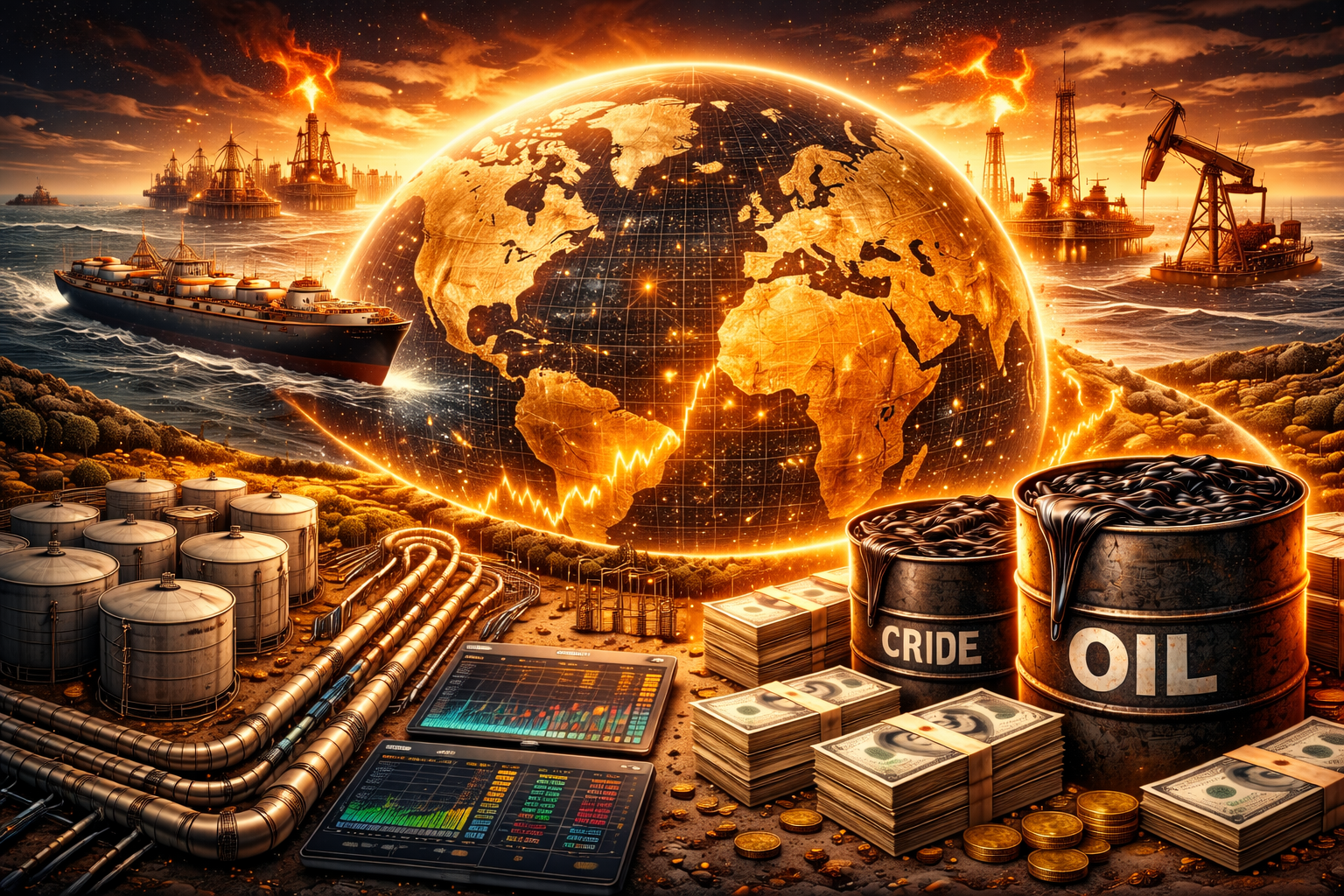
Oil is the single most important commodity in the global economy. Every day, the world consumes roughly 100 million barrels of crude oil, powering transportation systems, manufacturing industries, global trade, and modern infrastructure. Yet the global oil market is far more complex than simple supply and demand. Oil prices are influenced by geopolitics, shipping routes, financial markets, technological innovation, and the strategic decisions of governments and major producers. Understanding how the oil market works reveals one of the most important systems shaping the modern world.
Key Facts About the Global Oil Market
• The world consumes roughly 100 million barrels of oil per day
• Oil is traded globally through benchmarks such as Brent crude and West Texas Intermediate (WTI)
• Major shipping chokepoints control large portions of global oil flows
• Organizations such as OPEC coordinate production policies among major producers
• Financial markets heavily influence oil prices through futures trading
• Oil inventories and storage hubs act as buffers for supply and demand
The Global Oil Market Explained
The global oil market is a vast network connecting producers, traders, refiners, shipping companies, and consumers across the world. Crude oil is extracted from reservoirs underground, transported through pipelines or oil tankers, refined into usable products such as gasoline and diesel, and then distributed to consumers.
Because oil production and consumption are geographically separated, enormous quantities of crude must move across international trade routes. Major oil producers include countries such as Saudi Arabia, the United States, Russia, Iraq, Canada, and the United Arab Emirates. Meanwhile, some of the largest consumers include the United States, China, India, and Europe.
This global network forms the backbone of the modern energy system, linking production regions with consumption centers through pipelines, shipping lanes, storage hubs, and refineries.
The Geography of Oil: Global Energy Chokepoints
One of the most important features of the oil market is geography. Large portions of global oil trade pass through narrow shipping routes known as chokepoints. These routes act as critical gateways for global energy flows.
The Strait of Hormuz
The Strait of Hormuz is the most important oil chokepoint in the world. Located between Iran and Oman, this narrow passage connects the Persian Gulf to global markets. Approximately 20 million barrels of oil pass through this route every day, representing roughly one-fifth of global oil consumption.
Because so much oil passes through this narrow corridor, geopolitical tensions in the region can quickly affect global oil prices.
The Strait of Malacca
The Strait of Malacca is another major chokepoint connecting the Indian Ocean to the Pacific Ocean. It is a critical route for oil shipments traveling from the Middle East to Asian economies such as China, Japan, and South Korea.
Bab-el-Mandeb
Bab-el-Mandeb connects the Red Sea to the Gulf of Aden and forms part of the route linking the Suez Canal to global shipping lanes. Oil traveling between Europe and the Middle East often passes through this passage.
The Suez Canal
The Suez Canal allows ships to move between Europe and Asia without sailing around the entire African continent. This canal plays a major role in the movement of both crude oil and refined fuels.
The Turkish Straits
The Bosporus and Dardanelles connect the Black Sea to the Mediterranean and serve as important routes for oil exports from the Black Sea region.
These chokepoints illustrate how the global oil market depends heavily on transportation infrastructure and strategic geography.
OPEC and the Countries That Influence Oil Prices
Another key force shaping the oil market is the Organization of Petroleum Exporting Countries, commonly known as OPEC.
OPEC was founded in 1960 by Iran, Iraq, Kuwait, Saudi Arabia, and Venezuela. The purpose of the organization was to coordinate oil production policies among member countries and give producers greater influence over the global oil market.
Today OPEC works closely with several non-member producers, including Russia, in an alliance known as OPEC+. Together these countries control a large share of global oil production.
By adjusting production levels, OPEC+ can influence global supply and stabilize markets. When production cuts are announced, oil prices often rise because supply becomes tighter. Conversely, when production increases, prices may fall.
How the Oil Futures Market Sets Global Prices
While physical oil flows across oceans and pipelines, the price of oil is largely determined in financial markets.
Oil futures contracts allow traders to buy or sell oil at a predetermined price for delivery at a future date. These contracts are traded on exchanges such as the New York Mercantile Exchange and the Intercontinental Exchange.
Two major benchmarks dominate global oil pricing:
Brent crude serves as the main international oil benchmark and is widely used in Europe, Africa, and Asia.
West Texas Intermediate (WTI) is the primary benchmark used in North America.
Futures markets are forward-looking, meaning prices reflect expectations about future supply and demand rather than just current conditions.
Two important concepts in futures markets are backwardation and contango.
Backwardation occurs when current oil prices are higher than future prices, often indicating a tight supply environment.
Contango occurs when future prices are higher than current prices, often signaling abundant supply or high storage levels.
Global Oil Inventories and Storage
Oil storage plays a critical role in balancing the market. When production exceeds demand, oil is stored in tanks or strategic reserves. When demand exceeds supply, stored oil can be released.
One of the most important storage hubs is located in Cushing, Oklahoma, which serves as a key delivery point for WTI futures contracts.
Another major hub is Rotterdam in the Netherlands, a central location for energy distribution across Europe.
Countries also maintain strategic petroleum reserves that can be used during supply disruptions or emergencies.
Monitoring inventory levels allows analysts to assess whether the oil market is tightening or loosening.
The Economics of Oil Production
Oil production costs vary widely depending on the type of resource being developed.
Conventional oil fields are often the cheapest to produce because oil flows relatively easily from underground reservoirs.
Shale oil production uses hydraulic fracturing and horizontal drilling to extract oil trapped in shale rock formations. The United States has become a major producer thanks to these technologies.
Deepwater oil fields require complex offshore drilling operations that involve high costs and advanced engineering.
Oil sands resources require energy-intensive extraction processes that increase production costs.
These different sources of oil form a global cost curve. When prices rise, higher-cost resources become economically viable. When prices fall, production from expensive projects may decline.
Why the World Will Not Run Out of Oil Soon
Many people assume the world will eventually run out of oil. However, the issue is not simply how much oil exists underground.
The key question is how much oil can be produced economically at a given price.
Technological advances continue to expand the amount of recoverable oil. Improvements in drilling techniques, seismic imaging, and data analysis have allowed companies to access resources that were previously considered too difficult or expensive to develop.
As a result, global oil reserves have grown significantly over time despite decades of production.
The Future of the Global Oil Market
The future of the oil market will be shaped by a combination of technology, geopolitics, economic growth, and energy transition policies.
Advances in drilling and production technology may continue expanding recoverable resources. At the same time, governments around the world are investing in renewable energy and exploring ways to reduce carbon emissions.
Despite these changes, oil is expected to remain a critical part of the global energy system for decades.
Transportation, petrochemicals, aviation, shipping, and industrial processes continue to depend heavily on oil-based fuels.
Understanding how the oil market works is therefore essential for understanding the global economy itself.
From geopolitical tensions in strategic shipping routes to financial trading on global exchanges, the oil market reflects a complex system of forces shaping energy supply and prices.
And because oil remains the foundation of modern energy systems, this market will continue to influence global economic stability, geopolitical strategy, and technological innovation for many years to come.