

Eden Research PLC: Institutional Equity Analysis Of A Sustainable Crop Protection Company
Eden Research PLC
Ticker: AIM: EDEN
Exchange: London Stock Exchange AIM
Sector: Sustainable crop protection, biopesticides and agricultural technology
Report type: Educational institutional equity analysis
Prepared by: Sach Capital Limited
Purpose: Academic and illustrative use only
Report date: 24 June 2026
Coverage: Eden Research PLC
Important Educational Notice
This document has been prepared solely for educational, academic and illustrative purposes. It is not investment advice, financial advice, investment research, independent research, a personal recommendation, a financial promotion or an offer to buy or sell securities.
All valuation views, technical levels, scenarios, conviction scores and portfolio comments are hypothetical educational examples. They are designed to demonstrate an institutional-style equity analysis process. They should not be used as the basis for any investment decision.
Financial markets involve risk. Small-cap and AIM-listed equities can be highly volatile, illiquid and vulnerable to dilution, execution delays and large price movements. Past performance is not a reliable indicator of future results.
Contents
| Section | Description |
|---|---|
| 1 | Disclaimer |
| 2 | Executive summary |
| 3 | Final educational view |
| 4 | Company overview |
| 5 | Product and technology analysis |
| 6 | Sector and macro framework |
| 7 | Business model quality |
| 8 | Financial and valuation assessment |
| 9 | Scenario analysis |
| 10 | Technical analysis |
| 11 | Risk matrix |
| 12 | Catalyst analysis |
| 13 | Portfolio construction view |
| 14 | Institutional thesis |
| 15 | Final report conclusion |
1. Disclaimer
This report has been prepared by Sach Capital Limited solely for educational and illustrative use in connection with institutional-style financial analysis training.
The purpose of this report is to demonstrate approaches to business analysis, financial interpretation, valuation thinking, technical analysis, risk assessment and portfolio construction. It does not constitute investment advice, financial advice, regulated investment research, independent research, dealing advice, tax advice, legal advice or any other regulated service.
Nothing in this document should be interpreted as a recommendation to buy, sell, hold or otherwise transact in Eden Research PLC shares or any other financial instrument. References to valuation, upside, downside, technical levels, risk, catalysts, market opportunity or portfolio role are educational examples only.
The analysis is based on publicly available information, company announcements, market data and the attached price charts available at the time of preparation. Financial metrics, share prices, market capitalisation, cash balances, regulatory approvals and technical structures may change materially after the report date.
Readers are responsible for conducting their own independent due diligence and seeking appropriate professional advice before making any financial decision.
2. Executive Summary
Eden Research PLC is a small AIM-listed sustainable crop-protection company focused on biopesticides, biocontrol technologies and plastic-free microencapsulation. Its core commercial argument is straightforward: agriculture needs effective crop-protection tools, but conventional pesticides face growing regulatory, environmental and residue pressure. Eden is positioned as a specialist company attempting to convert that structural shift into commercial product growth.
The company’s principal technology platform is Sustaine, a naturally derived, plastic-free, biodegradable microencapsulation system. Its current and developing products are built around plant-derived terpene chemistry and controlled-release formulation. Eden’s established commercial products include Mevalone, a foliar biofungicide used initially in grapes and other high-value crops, and Cedroz, a bionematicide developed with Eastman for root-knot nematodes. The company is also progressing Ecovelex, a bird-repellent seed treatment, alongside newer insecticide and fungicide development opportunities.
The investment case has improved from a strategic standpoint. Eden has reported regulatory progress across Mevalone, Ecovelex and other product lines, a Syngenta distribution agreement in ornamentals, Kenyan distribution expansion through Andermatt, a Thymolflex EPA approval through partner Véto-pharma, and a material 2026 fundraise designed to accelerate product registration and commercialisation.
However, the equity case remains speculative. Revenue is still modest, losses continue, scale has not yet been proven and the business remains dependent on regulatory approvals, distributor execution and successful conversion of product authorisations into recurring sales. The April 2026 trading update expected revenue of approximately £4.9m for the 15 months to 31 March 2026, a PBT loss of approximately £2.9m and cash of approximately £9.0m after receipt of the second part of the fundraise.
The technical picture is not yet supportive. The daily chart shows price at 3.00p and below the main Ichimoku reference levels. The weekly chart shows the share price below the weekly conversion line, base line and cloud structure. The monthly chart remains in a long-term damaged trend, with price still below the larger Ichimoku cloud. Momentum is not yet confirming a durable recovery.
The final educational view is Speculative Hold / Watchlist. Eden has a credible sustainable agriculture platform and a stronger cash position after the fundraise, but the equity requires proof that recent regulatory and partnership milestones can translate into material sales growth and a clearer route to profitability.
3. Final Educational View
| Item | Assessment |
|---|---|
| Company | Eden Research PLC |
| Ticker | AIM: EDEN |
| Final educational view | Speculative Hold / Watchlist |
| Conviction score | 57/100 |
| Preferred horizon | 2-5 years |
| Technical rating | 3.8/10 |
| Fundamental quality | Medium, but early-stage |
| Risk level | High |
| Investment style | Speculative sustainable agriculture growth |
| Main theme | Biopesticide commercialisation and sustainable crop-protection transition |
| Key requirement for higher conviction | Revenue acceleration, cash-burn control and technical recovery above 3.50p-4.00p |
| Key downside risk | Product adoption delays, dilution risk, weak AIM liquidity and technical breakdown below 3.00p |
Eden is not a conventional defensive agriculture stock. It is a small-cap commercialisation story. The company has technology, regulatory progress and market relevance, but it has not yet demonstrated enough financial scale to justify a high-conviction accumulation view.
The positive case rests on the growing need for sustainable crop-protection products, Eden’s differentiated terpene and microencapsulation platform, broader regulatory approvals, partner-led commercialisation and the stronger balance sheet after the 2026 fundraise.
The cautionary case is equally important. The company remains loss-making, revenue is still small, recent growth must be proven in reported numbers, and the chart has not yet repaired. The shares are currently closer to watchlist territory than technical accumulation territory.
4. Company Overview
Eden Research PLC develops and supplies biopesticide products and natural microencapsulation technologies for the global crop protection, animal health and consumer products industries. Its listed equity trades on AIM under the ticker EDEN.
The company’s business is built around two related themes. The first is the use of naturally derived active ingredients, particularly terpenes, as sustainable alternatives to selected conventional crop-protection products. The second is its Sustaine encapsulation system, which is designed to improve delivery, release behaviour and performance while avoiding intentionally added plastic polymers.
Eden’s commercial products target high-value crop markets where yield, residue profile, export standards and disease control matter. This is important because growers of grapes, fruit, vegetables, ornamentals and other high-value crops may have stronger incentives to adopt products that support residue management, integrated pest management and access to premium markets.
The company is still transitioning from technology validation into commercial scale. That distinction is central. A product can be scientifically credible and still take years to build material revenue. Eden’s next stage depends on turning approvals, distribution agreements and field-trial progress into repeatable product sales.
Eden’s commercial model is also supported by relationships with established industry partners. Cedroz is commercialised with Eastman Chemical across multiple territories, Corteva Agriscience has been involved in Eden’s seed-treatment and French Mevalone/Esseva commercialisation strategy, and Sipcam Oxon has acted as a commercial partner for Eden’s biofungicide products in European markets. These relationships give Eden access to established agricultural registration, distribution and commercialisation channels, reducing the need for the company to build a large in-house global sales infrastructure.
| Category | Assessment |
|---|---|
| Core business | Sustainable biopesticides and biocontrol technology |
| Main platform | Sustaine plastic-free microencapsulation |
| Active chemistry focus | Plant-derived terpene active ingredients |
| Established products | Mevalone and Cedroz |
| Developing products | Ecovelex, insecticide, late blight fungicide, Septoria fungicide |
| Main markets | Crop protection, seed treatment, bee health, animal health and consumer applications |
| Listed status | AIM-listed small-cap equity |
| Revenue profile | Early commercial, still modest |
| Strategic position | Specialist sustainable crop-protection platform |
| Main challenge | Converting product approvals into meaningful recurring sales |
5. Product and Technology Analysis
Mevalone
Eden should not be viewed as a single-product crop-protection company. Its commercial portfolio is led by Mevalone, Cedroz and Ecovelex, but the company is also developing additional products aimed at major farmer needs. These include a late blight fungicide for potatoes, an insecticide targeting pests such as spider mites, whitefly, aphids and thrips, and a potential broad-acre Septoria fungicide for wheat. This broader pipeline is important because it gives Eden a pathway to address multiple crop-protection problems rather than relying solely on one product category.
Mevalone is Eden’s foliar biofungicide. It uses a controlled-release formulation of terpene active ingredients and was initially developed for Botrytis control in grapes. Its relevance has expanded as the company has gained additional approvals and label extensions.
The strategic value of Mevalone lies in its fit with high-value crops, integrated pest management programmes and residue-sensitive markets. Grapes, fruit and horticultural crops can support higher-value crop-protection economics than broad commodity crops, provided growers see reliable efficacy and distributors can build adoption.
Recent milestones have strengthened the Mevalone case. The company has highlighted approval in California for powdery mildew and a label extension in France covering powdery and downy mildew. These are significant because California and France are both important viticulture regions.
| Mevalone area | Assessment |
|---|---|
| Product type | Foliar biofungicide |
| Chemistry | Plant-derived terpene active ingredients |
| Platform | Sustaine microencapsulation |
| Original target | Botrytis in grapes |
| Wider use | Grapes, fruit, vegetables and other horticultural crops |
| Strategic importance | Core commercial product |
| Main upside | Wider label approvals and adoption in high-value crops |
| Main risk | Grower adoption, seasonal variability and distributor execution |
Cedroz
Cedroz is Eden’s bionematicide product. It targets root-knot nematodes, which can affect a wide range of high-value fruit and vegetable crops. It was developed in conjunction with Eastman Chemical Company.
Cedroz gives Eden exposure to soil pest control rather than only foliar disease control. That broadens the company’s product platform and gives it a second commercial product pillar. However, Eden’s economic benefit depends on the pace of registration, commercialisation and partner-led distribution.
| Cedroz area | Assessment |
|---|---|
| Product type | Bionematicide |
| Target | Root-knot nematodes |
| Commercial partner | Eastman Chemical Company |
| Main crops | High-value fruit and vegetables |
| Strategic importance | Second established commercial product |
| Main upside | Wider geographic approvals and partner sales |
| Main risk | Dependence on partner execution and grower conversion |
Ecovelex
Ecovelex is Eden’s bird-repellent seed treatment. It is designed to protect seeds from bird damage while leaving birds unharmed. It has attracted attention because the regulatory withdrawal of older chemical options has created gaps in seed treatment markets.
The product has secured temporary authorisation in Italy for use ahead of the maize growing season. Eden is also awaiting broader European approval. If that approval arrives and is followed by concerned member-state approvals, Ecovelex could become a more material commercial contributor.
The key distinction is timing. Temporary authorisations can support near-term sales, but broader recurring revenue depends on durable regulatory status, distributor capability and farmer adoption.
| Ecovelex area | Assessment |
|---|---|
| Product type | Bird-repellent seed treatment |
| Target use | Protection of maize and other seeds from bird damage |
| Regulatory status | Temporary Italian authorisations and broader EU approval awaited |
| Strategic importance | Potential new commercial growth driver |
| Main upside | EU approval and wider member-state adoption |
| Main risk | Regulatory timing and seasonal sales dependency |
Insecticide Pipeline
Eden is developing an insecticide product targeting pests such as spider mites, whitefly, aphids and thrips. The 2026 fundraise was partly designed to accelerate registration and commercialisation of this product.
This is important because it could move Eden into a broader pest-control market beyond fungicides and nematicides. The company has indicated interest from major crop-protection businesses, but the key point for investors is that development interest is not the same as commercial revenue. The next proof point is a signed commercial or development agreement.
| Insecticide area | Assessment |
|---|---|
| Target pests | Spider mites, whitefly, aphids and thrips |
| Stage | Development and commercial arrangement phase |
| Strategic value | Expands Eden beyond fungicide and nematicide use cases |
| Main upside | Partner agreement and accelerated registration |
| Main risk | Field trial, regulatory and commercial timing risk |
Fungicide 2 – Late Blight
Eden is also developing an additional fungicide for late blight, particularly relevant to potatoes. Late blight is a major disease area, and conventional chemical restrictions can create demand for alternative solutions.
The company has indicated positive testing by interested parties and expects commercial arrangements in H2 2026 or H1 2027. This is potentially meaningful, but still pre-commercial. It should be treated as pipeline value rather than current earnings value.
| Fungicide 2 area | Assessment |
|---|---|
| Target | Late blight |
| Main crop relevance | Potatoes |
| Stage | Development and partner-testing stage |
| Strategic value | Large disease target with potential commercial relevance |
| Main upside | Commercial agreement and registration progress |
| Main risk | Efficacy, registration, partner commitment and funding execution |
Septoria Fungicide
The conditional placing proceeds are partly intended to support development of a broad-acre crop fungicide for Septoria in wheat. This could be strategically important because wheat is a much larger crop category than Eden’s historical high-value fruit and vegetable focus.
However, broad-acre agriculture is competitive and cost-sensitive. Success would require not just efficacy, but strong economics, scalable distribution and reliable field performance.
| Septoria area | Assessment |
|---|---|
| Target | Septoria in wheat |
| Crop type | Broad-acre crop |
| Stage | Development |
| Strategic value | Potentially larger addressable market |
| Main upside | Expansion beyond specialist high-value crops |
| Main risk | Competitive intensity, price sensitivity and long development pathway |
Sustaine Technology
Sustaine is the company’s underlying microencapsulation system. It is naturally derived, plastic-free and biodegradable. Its purpose is to stabilise active ingredients and allow controlled release.
This is the heart of Eden’s platform. It can improve product performance, support differentiated formulations and align with regulatory pressure against synthetic polymer microplastics. It also creates optionality beyond existing products.
| Sustaine area | Assessment |
|---|---|
| Technology type | Natural microencapsulation |
| Material profile | Plastic-free and biodegradable |
| Core use | Controlled release of active ingredients |
| Commercial relevance | Used in Eden’s product formulations |
| Strategic value | Platform optionality across crop protection and other categories |
| Main risk | Technology value depends on commercial adoption |
6. Sector and Macro Framework
Eden sits at the intersection of agriculture, regulation, sustainability and small-cap equity risk.
The macro backdrop is favourable in concept. Farmers need crop protection. Regulators are scrutinising conventional chemistry. Food supply chains want lower residues and more sustainable inputs. Consumers and retailers increasingly favour reduced chemical exposure. These trends support demand for credible biopesticides and biocontrol products.
However, favourable sector direction does not automatically create shareholder value. Agriculture is conservative. Farmers adopt products when performance, price, timing and availability are proven. Distributors must be incentivised. Regulatory approvals take time. Sales can be seasonal. Weather can move demand from one year to the next.
For Eden, the sector opportunity is real, but the execution pathway remains demanding.
| Macro variable | Eden sensitivity | Interpretation |
|---|---|---|
| Agricultural commodity prices | Medium | Stronger farm economics may support input spending, but Eden’s high-value crop exposure reduces pure commodity dependence |
| Farmer income | High | Grower willingness to trial and repeat-use products depends partly on margin confidence |
| Regulatory approvals | Critical | Approvals and label extensions are central to addressable-market expansion |
| Conventional pesticide restrictions | High positive sensitivity | Product withdrawals can increase demand for sustainable alternatives |
| Input cost inflation | Medium | Inflation can pressure growers, but may also make lower-residue alternatives strategically valuable |
| Distributor execution | Critical | Eden’s commercial scale depends heavily on partners and distribution routes |
| Interest rates | Medium-high | Higher rates pressure AIM growth equities and increase the market’s focus on cash burn |
| AIM liquidity | Very high | Thin liquidity can amplify both rallies and sell-offs |
| Sterling exchange rates | Medium | International sales and partner economics can be affected by currency movements |
| Climate volatility | Medium-high | Disease pressure and pest pressure can increase demand, but weather can also disrupt seasonal sales |
| ESG and sustainability trends | High | Eden benefits thematically from the shift toward sustainable agriculture |
The sector conclusion is balanced. Eden operates in an attractive long-term niche, but it remains exposed to the normal difficulties of converting agricultural innovation into consistent commercial revenue.
7. Business Model Quality
Eden’s business model has attractive intellectual property and regulatory characteristics, but its commercial quality is still developing.
The positives are clear. The company owns a differentiated technology platform, has commercialised products, has partner relationships and has secured multiple approvals. It has a clear thematic fit with sustainable agriculture and the regulatory pressure facing conventional pesticides.
The weaknesses are also clear. Revenue is modest, the company remains loss-making and its ability to scale profitably has not yet been proven. Eden’s reliance on distributors and partners is efficient from a cost perspective, but it reduces direct control over the speed of market adoption.
| Area | Assessment |
|---|---|
| Revenue quality | Improving, but still early-stage |
| Earnings visibility | Limited |
| Gross margin potential | Potentially attractive if product sales scale |
| Regulatory dependence | Very high |
| Distributor dependence | Very high |
| Scalability | Theoretically strong, but not yet proven financially |
| Intellectual property | Meaningful, centred on Sustaine and terpene formulations |
| Product-market fit | Credible in sustainable crop protection |
| Balance sheet resilience | Improved after 2026 fundraise |
| Cash burn risk | Still relevant |
| Dilution risk | Reduced near term, but not eliminated |
| Market adoption risk | High |
| Main constraint | Proof of commercial scale |
8. Financial and Valuation Assessment
Eden remains an early commercial-stage company. The financial story is not yet about earnings quality. It is about revenue growth, cash runway, product adoption and the timing of a move toward profitability.
The company’s H1 2025 results showed revenue of £1.2m, product sales of £1.1m, an operating loss of £1.7m and cash of £1.8m at 30 June 2025. The April 2026 trading update gave a more current picture, with expected revenue of approximately £4.9m for the 15 months to 31 March 2026, expected PBT loss of approximately £2.9m and cash of approximately £9.0m following the second part of the fundraise.
The fundraise materially changed the near-term balance sheet. It reduced immediate funding pressure and gave Eden capital to accelerate product development and registration. However, it also increased the share count and demonstrated the business’s reliance on equity capital while it remains loss-making.
| Metric | Assessment |
|---|---|
| Current share price area | Approximately 3.00p |
| Market capitalisation | Approximately £24.5m |
| Shares outstanding | Approximately 803m |
| Latest expected revenue | Approximately £4.9m for 15 months to 31 March 2026 |
| Latest expected PBT | Approximately £2.9m loss for 15 months to 31 March 2026 |
| Post-fundraise cash | Approximately £9.0m |
| 2024 revenue | £4.3m |
| 2024 product sales | £3.6m |
| 2024 operating loss | Approximately £2.2m |
| Dividend | None |
| Profitability status | Loss-making |
| Balance sheet | Improved after fundraise |
| Main financial risk | Cash burn and future dilution if revenue scale disappoints |
Valuation View
At approximately 3.00p per share and a market capitalisation near £24.5m, Eden is not valued like a distressed shell. The market is still giving value to its technology, approvals, pipeline and optionality.
Using the post-fundraise cash figure of approximately £9.0m, the implied enterprise value is roughly £15m-£16m, before adjusting for cash movements after the trading update. Against expected 15-month revenue of approximately £4.9m, that implies an enterprise-value-to-sales ratio of roughly 3.1x to 3.3x. On a simple market-cap-to-sales basis, the ratio is around 5.0x using the 15-month revenue figure.
That valuation is not extreme for a specialist sustainable agriculture platform with funded product development. However, it is not cheap for a business that remains loss-making and commercially subscale. The valuation only becomes compelling if revenue begins to scale materially and the company can demonstrate a credible pathway to profitability.
| Valuation lens | Interpretation |
|---|---|
| Price-to-sales | Moderate to high for a loss-making small-cap |
| Enterprise value-to-sales | More reasonable after adjusting for cash |
| Profit-based valuation | Not meaningful yet |
| Cash-adjusted valuation | More supportive after fundraise |
| Scenario valuation | Highly sensitive to sales growth assumptions |
| Dilution-adjusted view | Important because recent equity issuance expanded share count |
| Overall valuation view | Fair for optionality, but dependent on execution |
9. Scenario Analysis
Bear Case
In the bear case, Eden’s regulatory progress fails to convert into meaningful sales acceleration. Product adoption remains slower than expected, distributor execution is uneven and the company continues to report operating losses. The stronger cash position extends the runway, but revenue does not scale quickly enough to remove future funding concerns.
| Bear case factor | Assessment |
|---|---|
| Revenue | Slower growth than expected |
| Cash | Declines as development spend continues |
| Profitability | Delayed |
| Product approvals | Slower or less commercially useful than expected |
| Distributor performance | Inconsistent |
| Technical structure | Breaks below 3.00p and retests 2.50p-2.00p |
| Valuation implication | Market discounts optionality and focuses on cash burn |
The bear case is not based on product failure alone. It can occur simply through slower adoption, delayed partner agreements or weaker repeat sales.
Base Case
In the base case, Eden gradually converts recent approvals and partnerships into higher product sales. Mevalone and Cedroz continue to expand across territories, Ecovelex gains regulatory momentum and the company signs development or commercial arrangements for its insecticide and late blight pipeline.
Losses remain present, but the cash position allows management to invest through the next stage without immediate balance-sheet stress. The equity stabilises technically and begins to rebuild if price reclaims the 3.50p-4.00p area.
| Base case factor | Assessment |
|---|---|
| Revenue | Gradual improvement |
| Cash | Sufficient for near-term development plan |
| Profitability | Still future-facing, but pathway improves |
| Product approvals | Incremental progress |
| Distributor performance | Better but not explosive |
| Technical structure | Stabilisation above 3.00p, recovery above 3.50p |
| Valuation implication | Current valuation becomes more defensible |
This is the most balanced educational scenario. It recognises strategic progress without assuming immediate commercial inflection.
Bull Case
In the bull case, Eden’s recent approvals and funded pipeline produce a step-change in investor perception. Product sales accelerate, Ecovelex secures broader European authorisation, Mevalone gains further market access, the insecticide attracts a major commercial partner and Fungicide 2 moves toward a defined commercial pathway.
The market begins to value Eden less as a subscale loss-making small-cap and more as a funded sustainable crop-protection platform with expanding commercial reach.
| Bull case factor | Assessment |
|---|---|
| Revenue | Material acceleration |
| Cash | Supports product registration and commercial investment |
| Profitability | Pathway becomes more visible |
| Product approvals | Multiple approvals or label extensions |
| Distributor performance | Stronger repeat sales and territory expansion |
| Technical structure | Breakout above 4.00p, then 5.00p |
| Valuation implication | Optionality re-rates if growth becomes visible |
The bull case requires evidence. The share price should not be valued on hope alone. The evidence required would be stronger reported revenue, a narrowing loss profile, tangible product agreements and a clear technical reversal.
10. Technical Analysis
The attached TradingView charts show Eden Research PLC across daily, weekly and monthly timeframes as of 24 June 2026. The share price is quoted in GBX.
Daily Chart – Figure EDEN-D
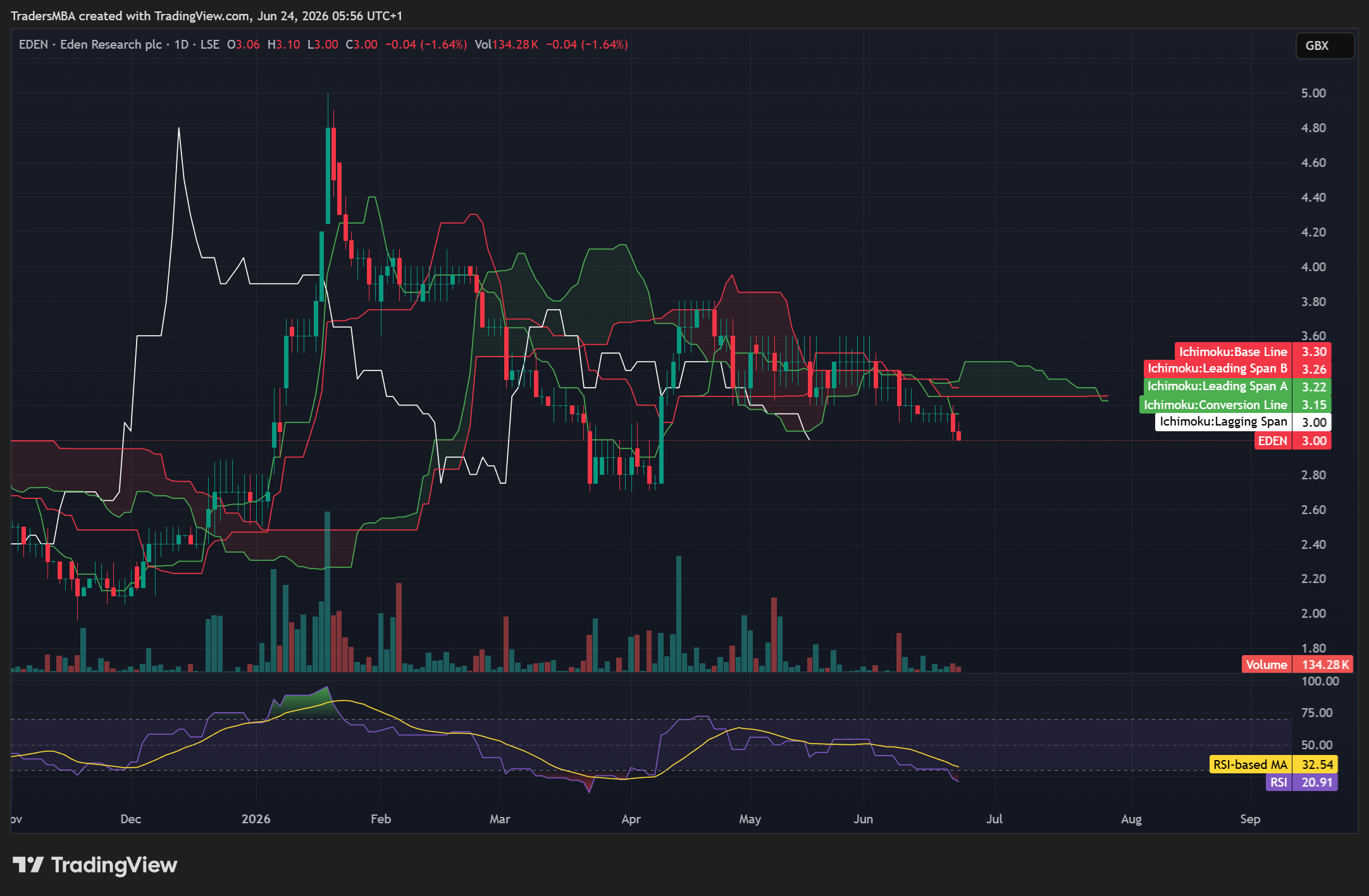
The daily chart is technically weak. Price is trading at 3.00p, below the key Ichimoku reference points. The conversion line is around 3.15p, Leading Span A is around 3.22p, Leading Span B is around 3.26p and the base line is around 3.30p. That means the price is below the short-term trend line, below the base line and below the projected cloud.
This is not a confirmed recovery structure. It is a short-term bearish structure with oversold characteristics.
The daily RSI is around 20.91, with its RSI-based moving average around 32.54. That shows heavy downside momentum in the near term. An RSI near 20 can create rebound risk, but it is not automatically bullish. In weak small-cap charts, oversold conditions can persist.
The daily support zone begins at 3.00p. A clean break below 3.00p would expose 2.80p, then the 2.60p-2.70p area. Below that, the market may look back toward the late-2025 support region around 2.00p-2.25p.
The daily resistance zone begins at 3.15p. A stronger technical repair would require price to reclaim 3.22p-3.30p. A move above 3.50p would be more constructive. A close above 4.00p would be the first stronger evidence that the post-January correction has begun to reverse.
| Daily technical item | Assessment |
|---|---|
| Price | 3.00p |
| Short-term bias | Bearish, but oversold |
| Ichimoku position | Below conversion line, base line and cloud |
| RSI | Oversold near 20.91 |
| Volume | No clear accumulation signal at the latest candle |
| Key support | 3.00p, then 2.80p and 2.60p |
| Key resistance | 3.15p, 3.22p-3.30p, 3.50p, 4.00p |
| Daily conclusion | Needs reclaim of 3.30p before short-term repair improves |
Weekly Chart – Figure EDEN-W

The weekly chart shows a longer-term share-price decline followed by a sharp January 2026 spike and subsequent retracement. The stock rallied aggressively toward 5.00p earlier in 2026 but has since faded back to 3.00p.
The weekly Ichimoku structure remains poor. Price is below the weekly conversion line at around 3.35p, below Leading Span B near 3.48p, below Leading Span A near 3.55p and below the weekly base line near 3.75p. That means the medium-term structure is still corrective.
The weekly RSI is around 42.41, below its RSI-based moving average around 50.20. That is not deeply oversold, but it shows weakening momentum. The key issue is that weekly momentum has not confirmed a higher-quality trend reversal.
The important weekly support is 3.00p. If that fails, the next meaningful areas are 2.50p, 2.25p and 2.00p. Resistance is layered between 3.35p and 3.75p. A weekly close above 3.75p would improve the structure. A weekly close above 4.00p would be more important because it would show that buyers have absorbed the post-spike supply.
| Weekly technical item | Assessment |
|---|---|
| Price | 3.00p |
| Medium-term bias | Bearish-to-neutral |
| Ichimoku position | Below major weekly reference lines |
| RSI | Weak, but not extreme |
| Key support | 3.00p, 2.50p, 2.25p, 2.00p |
| Key resistance | 3.35p, 3.48p-3.55p, 3.75p, 4.00p |
| Weekly conclusion | Medium-term repair requires a weekly close above 3.75p-4.00p |
Monthly Chart – Figure EDEN-M

The monthly chart is the weakest timeframe from an institutional perspective. It shows a long-term decline from much higher levels, failed recoveries and an extended period of price compression near the lower end of the long-term range.
The monthly Ichimoku picture remains damaged. The price is around 3.00p, while the monthly conversion line, base line and Leading Span A are all around 3.48p. Leading Span B is much higher, around 7.06p. This means Eden remains below the long-term cloud and below the first major monthly repair zone.
The monthly RSI is around 45.48, slightly above its RSI-based moving average around 44.36. That is one of the few more constructive elements in the chart, because it suggests long-term momentum is not deteriorating as aggressively as the daily timeframe. However, it is still not strong enough to confirm a bullish regime.
The monthly technical structure needs a close above 3.48p first. A sustained move above 5.00p would be a more significant signal. The long-term chart only improves materially if Eden begins building a base above the 3.50p-4.00p area and eventually challenges 7.00p.
| Monthly technical item | Assessment |
|---|---|
| Price | 3.00p |
| Long-term bias | Weak, but attempting to base |
| Ichimoku position | Below cloud and below key monthly lines |
| RSI | Neutral-to-slightly improving |
| Key support | 3.00p, 2.00p-2.25p |
| Key resistance | 3.48p, 5.00p, 7.06p |
| Monthly conclusion | Long-term repair requires a sustained move above 3.48p, then 5.00p |
Technical Summary
| Timeframe | Bias | Key support | Key resistance | Interpretation |
|---|---|---|---|---|
| Daily | Bearish, oversold | 3.00p, 2.80p | 3.15p, 3.30p, 3.50p | Weak short-term structure, but rebound risk due to oversold RSI |
| Weekly | Bearish-to-neutral | 3.00p, 2.50p, 2.00p | 3.35p, 3.75p, 4.00p | Medium-term trend repair has not yet occurred |
| Monthly | Weak, basing attempt | 3.00p, 2.00p | 3.48p, 5.00p, 7.06p | Long-term chart remains damaged below major resistance |
Technical Rating
Technical rating: 3.8/10
The rating is low because all three timeframes remain technically fragile. The daily chart is below key Ichimoku levels, the weekly chart has not repaired after the January 2026 spike, and the monthly chart remains below its long-term cloud. The only constructive element is that price is testing a known psychological support area around 3.00p and the monthly RSI is not collapsing.
11. Risk Matrix
| Risk | Probability | Severity | Explanation |
|---|---|---|---|
| Regulatory approval risk | Medium | High | Eden’s addressable market depends on approvals, label extensions and member-state authorisations |
| Commercialisation risk | High | High | Product approval does not guarantee grower adoption or repeat purchases |
| Distributor execution risk | High | High | Eden relies heavily on commercial partners and distributors to scale sales |
| Revenue concentration risk | Medium | Medium-high | Revenue remains modest and dependent on a limited number of products and territories |
| Cash burn risk | Medium | High | The fundraise improved runway, but losses remain |
| Dilution risk | Medium | High | Future equity raises could occur if revenue growth lags development spending |
| AIM liquidity risk | High | Medium-high | Thin liquidity can amplify price moves and widen spreads |
| Small-cap volatility risk | High | High | EDEN can move sharply on RNS news, sentiment and low-volume trading |
| Product adoption risk | High | High | Farmers and distributors require performance, price and reliability before repeat use |
| Competitive risk | Medium | Medium-high | Larger crop-protection groups have deeper resources and global distribution |
| Technical breakdown risk | Medium-high | High | A break below 3.00p would weaken the chart and could retest lower support zones |
| Reporting-transition risk | Medium | Medium | The 15-month reporting period makes year-on-year comparisons less clean |
| Execution risk | High | High | Eden must manage product development, approvals, distribution and cash discipline simultaneously |
12. Catalyst Analysis
| Positive catalysts | Negative catalysts |
|---|---|
| Broader Ecovelex European approval | Regulatory delays for Ecovelex |
| Commercial agreement for the insecticide product | Failure to sign expected commercial agreements |
| Mevalone approval in additional territories | Weak product-sales growth |
| Further removal of United States label restrictions | Continued losses despite fundraise |
| Commercial arrangements for Fungicide 2 | Cash burn running ahead of revenue growth |
| Stronger sales from Syngenta and Andermatt channels | Distributor underperformance |
| Additional crop approvals and label extensions | Farmer adoption below expectations |
| Evidence that revenue is moving toward profitability | Equity dilution concerns returning |
| Technical recovery above 3.50p and 4.00p | Technical breakdown below 3.00p |
| Improved liquidity and institutional interest | AIM market risk appetite deteriorates |
The most important catalysts are not just regulatory announcements. The critical catalysts are revenue evidence and commercial conversion. A small-cap can announce many approvals, but the market will eventually demand proof that those approvals translate into sales, margin and cash flow.
13. Portfolio Construction View
Eden’s educational portfolio role is best understood as a speculative satellite exposure, not a core holding. It has thematic relevance, intellectual property and funded pipeline optionality, but the risks are too high for it to be treated as a defensive or predictable equity.
| Category | Assessment |
|---|---|
| Best portfolio role | Speculative sustainable agriculture satellite |
| Position size view | Small only in an educational model portfolio |
| Suitable investor type | High-risk investor comfortable with AIM volatility and long development timelines |
| Unsuitable investor type | Income investor, low-volatility investor or investor requiring near-term profitability |
| Volatility expectation | High |
| Liquidity consideration | Important, due to small-cap AIM trading characteristics |
| Risk-management comment | Conviction should be increased only after revenue, cash and technical evidence improves |
In an institutional framework, Eden would sit in a high-risk thematic bucket. It is not yet a cash-flow compounder. It is a proof-of-commercialisation equity.
14. Institutional Thesis
The strongest institutional argument for Eden is that the company is positioned in the right structural direction. Agriculture needs sustainable crop-protection tools. Conventional pesticide pressure is real. Residue-sensitive food supply chains create demand for alternative products. Plastic-free formulation technology has strategic relevance. Eden has real products, not just an early concept.
The company has also made visible progress. Mevalone has broadened its market reach, Cedroz gives a second commercial pillar, Ecovelex has the potential to become a more important seed-treatment product, and the newer insecticide and fungicide pipeline could expand the company’s addressable market. The 2026 fundraise gives Eden more room to execute rather than operating under immediate funding strain.
A further strategic optionality angle is that Eden may become more attractive to larger crop-protection and agriscience companies if it continues to de-risk its platform. Broader Ecovelex approval, stronger product sales, additional registrations and progress across pipeline products such as late blight fungicide would make the company’s technology, product portfolio and commercial relationships more valuable. However, this should be framed as optionality rather than a core investment assumption, as there is no confirmed public offer or formal takeover approach.
The weakness is that the equity case remains ahead of the financial evidence. Eden is still small in revenue terms and loss-making. Its valuation depends on the market assigning credit to future product adoption, future approvals and future partner-led growth. That is acceptable for a speculative growth equity, but it requires disciplined evidence tracking.
The most important institutional question is not whether Eden’s theme is attractive. It is whether Eden can scale from regulatory progress into repeatable commercial economics. The market will likely become more constructive if three things happen together:
- Product sales begin to accelerate clearly.
- Cash burn remains controlled.
- The share price reclaims the 3.50p-4.00p technical zone.
Until then, Eden remains a credible but speculative watchlist equity.
15. Final Report Conclusion
Eden Research PLC has a legitimate strategic position in sustainable crop protection. Its Sustaine technology, terpene-based products, Mevalone approvals, Cedroz platform, Ecovelex opportunity, Syngenta agreement, Andermatt expansion and newly funded pipeline create a credible long-term commercial story.
The problem is not the absence of a thesis. The problem is the level of proof. Revenue is still modest, losses remain, scale is unproven and the equity chart is technically weak. The April 2026 fundraise materially improved the company’s cash position, but it also highlighted the need for external capital while the business continues to invest ahead of profitability.
From a technical perspective, 3.00p is the immediate support level. A clean break below that area would weaken the setup and expose lower levels. A recovery above 3.30p would begin short-term repair. A move above 3.50p-4.00p would be more meaningful. A sustained move above 5.00p would suggest the market is beginning to reprice the story more aggressively.
Final educational view: Speculative Hold / Watchlist
Conviction score: 57/100
Technical rating: 3.8/10
Risk level: High
Preferred horizon: 2-5 years
Eden is a potentially interesting sustainable agriculture equity, but it is not yet a high-conviction institutional accumulation case. The next stage requires hard evidence: stronger product sales, visible commercial agreements, regulatory delivery, cash discipline and a repaired share-price structure.