
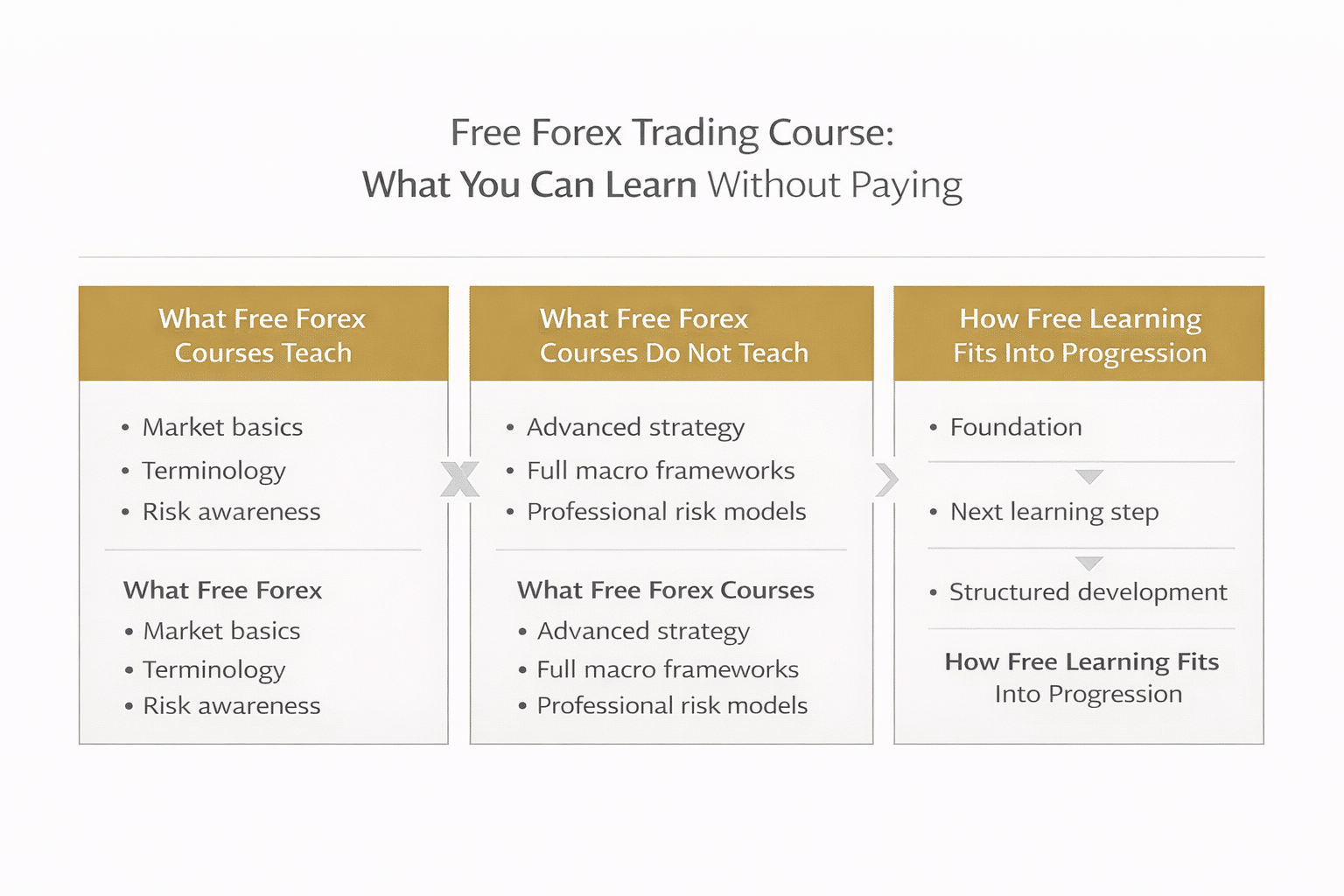
Free Forex Trading Course: What You Can Learn Without Paying
Introduction
Free forex trading course searches come from beginners who want to learn how the forex market works before committing money to education or live trading. While free resources can be useful, many traders struggle to understand what free forex trading courses actually teach, what they do not cover, and how to use free forex education effectively. This guide explains what a free forex trading course includes, how beginners can learn forex trading for free the right way, and when free learning stops being enough.
A free forex trading course is an educational resource that teaches the basics of currency markets, analysis, and risk awareness without payment, primarily designed for beginners.
What a Free Forex Trading Course Covers
A free forex trading course focuses on orientation rather than mastery.
Most free forex trading courses explain how the forex market operates, how currency pairs are quoted, and how trades are placed. They introduce essential terminology and basic decision-making concepts so beginners understand what they are trading.
Free forex trading education builds familiarity and confidence, not professional-level skill.
Core Topics in Free Forex Trading Courses
Although depth varies, most free online forex trading courses include similar foundational topics.
Forex Market Basics
Free forex trading courses typically start with currency pairs, pips, leverage, margin, spreads, and trading sessions. This helps beginners understand price quotation and basic market mechanics.
Why Currency Prices Move
Free forex education introduces the idea that currencies move based on economic conditions rather than randomness. Beginners learn that interest rates, inflation, and growth influence exchange rates.
Professional explanations often reference macro data used by institutions such as the International Monetary Fund to explain why currencies react to economic changes.
Basic Technical Analysis
Most free forex trading courses introduce charts, trends, and simple support and resistance. The goal is awareness, not strategy optimisation.
This prevents beginners from trading blindly or emotionally.
Risk Awareness for Beginners
Free forex trading education usually explains stop losses and leverage risk. While simplified, this exposure helps beginners avoid the most common early mistakes.
What Free Forex Trading Courses Do Not Teach
Understanding the limits of free forex trading courses is essential.
Free courses rarely provide structured progression, detailed macro frameworks, or advanced risk management. They often lack clear learning paths, making it difficult for beginners to know what to study next.
A free forex trading course is an entry point, not a complete trading education.
Free Forex Trading Course vs Paid Courses
The difference between free and paid forex courses is structure and depth.
Free forex trading courses explain what forex is and how trades work. Paid courses typically offer step-by-step progression, integrated analysis, professional workflows, and long-term development paths.
Free forex education answers “what is forex,” while structured courses explain “how to trade forex consistently.”
Can You Learn Forex Trading for Free?
Yes, beginners can learn forex trading basics for free.
Free forex trading courses can teach how the market works, how trades are placed, and why risk matters. However, consistency, decision-making, and professional-level discipline usually require deeper, structured learning.
Free learning lowers the barrier to entry but does not remove the learning curve.
Who Free Forex Trading Courses Are Best For
Free forex trading courses are best suited for:
- Complete beginners exploring forex for the first time
- Traders learning terminology and market structure
- Those testing interest before committing time or money
They are not designed to replace comprehensive forex education.
Common Mistakes When Using Free Forex Trading Courses
Many beginners misuse free resources.
Common mistakes include jumping between multiple free forex courses, focusing on strategies too early, ignoring risk management, and expecting free content to deliver professional results.
Using free forex trading courses correctly means treating them as foundations, not shortcuts.
How to Progress After a Free Forex Trading Course
After completing a free forex trading course, beginners should consolidate learning.
This includes practising in a controlled environment, deepening understanding of price drivers, and gradually learning structured analysis. Internal paths such as a beginner forex guide or introductory risk management lessons support this progression.
Why Free Forex Trading Courses Still Matter
Free forex trading courses play an important role in education.
They allow beginners to explore the market safely, understand terminology, and decide whether forex trading suits them before committing capital or structured study.
When used correctly, free forex trading education provides a valuable foundation for long-term development.
FAQs
What is a free forex trading course?
A free forex trading course is an educational resource that teaches forex basics such as market structure, price movement, and risk awareness without payment. It is primarily designed for beginners.
Are free forex trading courses effective?
Free forex trading courses are effective for learning fundamentals and terminology. However, they usually lack the depth and structure required for consistent long-term trading.
Can beginners learn forex trading for free?
Yes, beginners can learn forex trading basics for free. Free courses help build understanding before progressing to more structured education or live trading.
What are the limitations of free forex trading courses?
Limitations include fragmented content, limited depth, and lack of structured progression. Free courses are best used as an introduction rather than a complete learning solution.
When should traders move beyond free forex trading courses?
Traders should move beyond free courses once they understand the basics and want structured frameworks, deeper analysis, and professional-level risk management.