
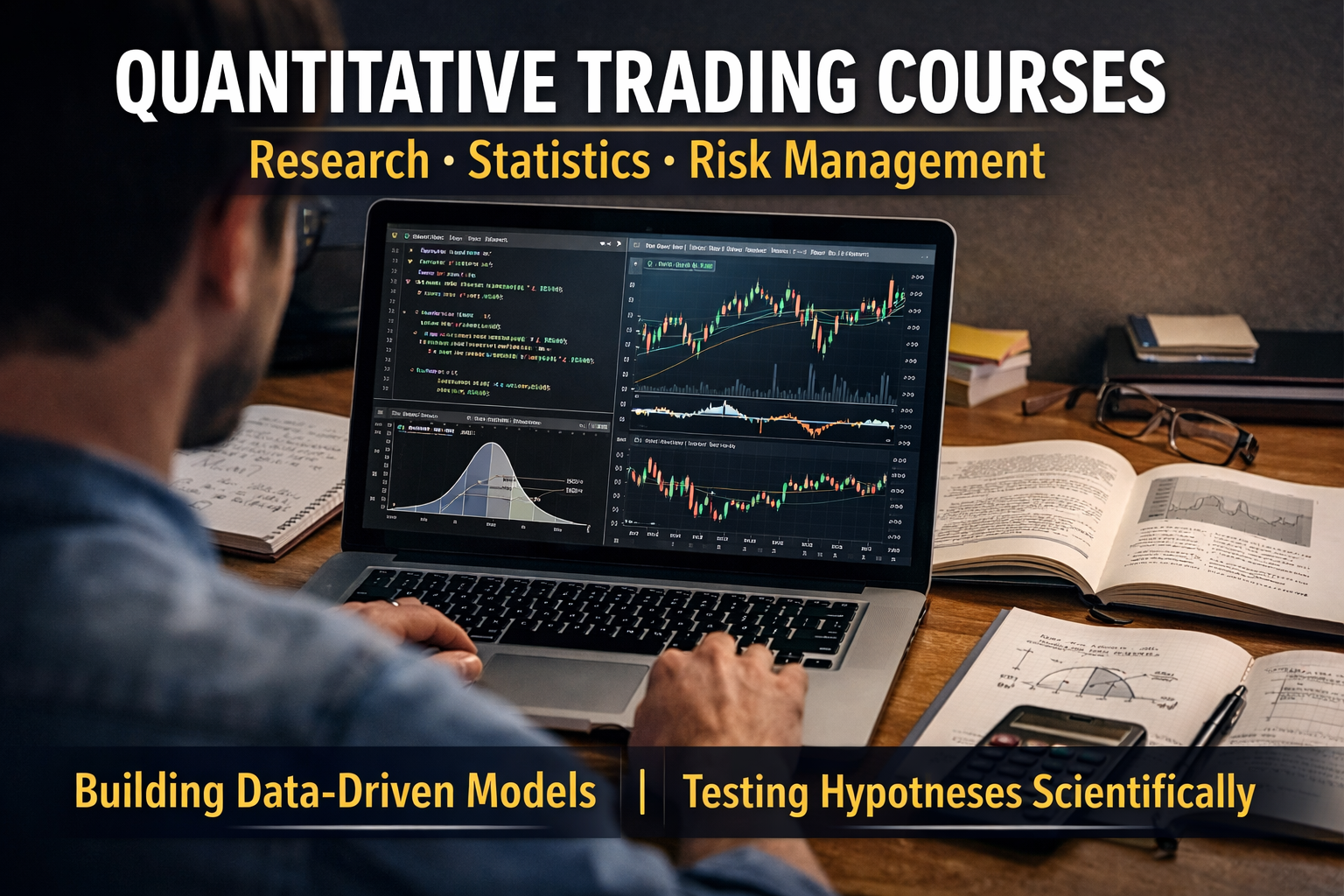
Quantitative Trading Courses: What You Learn vs What You Expect
Quantitative trading courses attract learners who want to apply mathematics, statistics, and data science to financial markets. Many expect these courses to deliver complex models that consistently outperform the market. In reality, quantitative trading courses focus on research discipline, statistical reasoning, and model validation, not guaranteed performance or predictive certainty.
Quantitative trading courses teach how to research, test, and manage data-driven trading models using statistical and mathematical methods rather than discretionary judgement.
What Quantitative Trading Courses Are Designed to Teach
Quantitative trading courses are built around research-first thinking. Their purpose is to teach how hypotheses about markets are formed, tested, rejected, or refined using data.
High-quality courses emphasise:
- Statistical reasoning over intuition
- Evidence-based decision-making
- Model robustness and limitations
- Continuous evaluation and refinement
The objective is scientific process, not prediction.
Core Topics Covered in Quantitative Trading Courses
Most reputable quantitative trading courses share a common academic and practical foundation.
Statistics and Probability for Trading
Learners are introduced to:
- Probability distributions
- Correlation vs causation
- Statistical significance and confidence
This underpins all quantitative research.
Data Analysis and Feature Engineering
Courses explain how to:
- Clean and structure market data
- Select meaningful inputs
- Avoid data leakage and bias
Data quality often matters more than model complexity.
Model Development and Testing
Students learn how to:
- Build simple quantitative models
- Test them across regimes
- Identify overfitting and false edges
Complexity is treated as a risk, not a goal.
Risk Management in Quantitative Strategies
Robust courses integrate:
- Portfolio-level risk controls
- Volatility and drawdown limits
- Correlation management
Risk governs model survival.
What Learners Often Expect Instead
Many learners start quantitative trading courses expecting:
- Advanced predictive models
- Guaranteed statistical edges
- Machine learning as a shortcut
- Immediate real-world applicability
These expectations rarely align with professional practice.
What Quantitative Trading Courses Do Well
When designed properly, quantitative trading courses excel at:
- Teaching disciplined research methods
- Reducing cognitive bias
- Improving risk awareness
- Encouraging humility toward data
They improve analytical quality, not certainty.
What Quantitative Trading Courses Cannot Do
No quantitative trading course can:
- Eliminate uncertainty
- Guarantee outperformance
- Prevent regime shifts
- Replace ongoing research
Markets evolve faster than static models.
Quantitative Trading Courses vs Algorithmic Trading Courses
Quantitative trading courses focus on research and modelling, while algorithmic trading courses focus on execution and automation.
- Quant = “Does this idea statistically hold?”
- Algo = “How do we implement rules consistently?”
Confusing the two leads to unrealistic expectations.
Who Quantitative Trading Courses Are Best Suited For
These courses are best for learners who:
- Enjoy mathematics and statistics
- Are comfortable with data analysis
- Accept slow, iterative progress
- Value research over results
They are not ideal for those seeking fast or simple outcomes.
How to Evaluate a Quantitative Trading Course Properly
Before enrolling, ask:
- Does it address overfitting clearly?
- Are assumptions challenged openly?
- Is risk treated as central, not optional?
Courses that avoid these areas should raise concern.
Are Quantitative Trading Courses Worth It?
Quantitative trading courses are worthwhile for those seeking deeper analytical rigour. They build strong research frameworks, but long-term success still depends on adaptation, risk control, and continuous learning.
Frequently Asked Questions
What do quantitative trading courses actually teach?
They teach how to research, test, and manage data-driven trading models using statistical and mathematical methods.
Do quantitative trading courses guarantee profits?
No. Statistical models are subject to regime change, data limitations, and execution risk.
Are quantitative trading courses suitable for beginners?
They can be, but beginners benefit most if they already understand basic markets and risk concepts.
Is machine learning essential in quantitative trading courses?
No. Many successful quantitative approaches rely on simple, well-tested statistical models.
How are quantitative trading courses different from algorithmic trading courses?
Quantitative courses focus on research and model validity, while algorithmic courses focus on rule execution and automation.